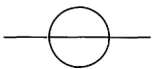
10.1

Problem 10.1

peskinChapter 10

习题 10.1

来源: 第10章, PDF第344页


10.1 One-loop structure of QED. In Section 10.1 we argued from general principles that the photon one-point and three-point functions vanish, while the four-point function is finite.

(a) Verify directly that the one-loop diagram contributing to the one-point function vanishes. There are two Feynman diagrams contributing to the three-point function at one-loop order. Show that these cancel. Show that the diagrams contributing to any nn-point photon amplitude, for nn odd, cancel in pairs.

(b) The photon four-point amplitude is a sum of six diagrams. Show explicitly that the potential logarithmic divergences of these diagrams cancel.

习题 10.1 - 解答


(a) 光子单点、三点及奇数点函数的单圈图抵消(Furry定理)

1. 光子单点函数 (One-point function) 光子单点函数在单圈水平上由一个连接到费米子圈的单光子外线构成。根据费曼规则,其振幅 Πμ\Pi^\mu 为: Πμ=(ie)d4p(2π)4Tr[γμi(+m)p2m2]\Pi^\mu = -(-ie) \int \frac{d^4p}{(2\pi)^4} \text{Tr}\left[ \gamma^\mu \frac{i(\not{p} + m)}{p^2 - m^2} \right] 计算狄拉克矩阵的迹: Tr[γμ]+mTr[γμ]=4pμ+0=4pμ\text{Tr}[\gamma^\mu \not{p}] + m\text{Tr}[\gamma^\mu] = 4p^\mu + 0 = 4p^\mu 代入积分中得到: Πμ=4ed4p(2π)4pμp2m2\Pi^\mu = 4e \int \frac{d^4p}{(2\pi)^4} \frac{p^\mu}{p^2 - m^2} 被积函数 pμp2m2\frac{p^\mu}{p^2 - m^2} 是关于回路动量 pp 的奇函数(即 ppp \to -p 时变号),而积分区间在全动量空间是对称的。因此,该积分严格为零: Πμ=0\boxed{\Pi^\mu = 0}

2. 光子三点函数及奇数点函数的抵消 对于任意 nn 点光子振幅的单圈图,存在两种费米子回路动量流向相反的费曼图。设外光子动量为 k1,,knk_1, \dots, k_n,对应的洛伦兹指标为 μ1,,μn\mu_1, \dots, \mu_n。 第一种流向的图(记为 M1\mathcal{M}_1)包含如下形式的迹: M1d4pTr[γμ1SF(p1)γμ2SF(p2)γμnSF(pn)]\mathcal{M}_1 \propto \int d^4p \, \text{Tr}\left[ \gamma^{\mu_1} S_F(p_1) \gamma^{\mu_2} S_F(p_2) \cdots \gamma^{\mu_n} S_F(p_n) \right] 其中 SF(p)=imS_F(p) = \frac{i}{\not{p}-m} 是费米子传播子。 引入电荷共轭矩阵 CC,它满足 CγμC1=(γμ)TC \gamma^\mu C^{-1} = -(\gamma^\mu)^T 以及 CSF(p)C1=SF(p)TC S_F(p) C^{-1} = S_F(-p)^T。在迹的每个因子之间插入 C1C=1C^{-1}C = 1Tr[γμ1SF(p1)]=Tr[C1Cγμ1C1CSF(p1)C1C]\text{Tr}\left[ \gamma^{\mu_1} S_F(p_1) \cdots \right] = \text{Tr}\left[ C^{-1} C \gamma^{\mu_1} C^{-1} C S_F(p_1) C^{-1} C \cdots \right] =Tr[((γμ1)T)SF(p1)T((γμ2)T)SF(p2)T((γμn)T)SF(pn)T]= \text{Tr}\left[ (-(\gamma^{\mu_1})^T) S_F(-p_1)^T (-(\gamma^{\mu_2})^T) S_F(-p_2)^T \cdots (-(\gamma^{\mu_n})^T) S_F(-p_n)^T \right] 提取出 nn 个负号,并利用矩阵转置的性质 Tr[ATBT]=Tr[BA]\text{Tr}[A^T B^T \cdots] = \text{Tr}[\cdots B A],将迹的顺序完全逆转: =(1)nTr[SF(pn)γμnSF(p2)γμ2SF(p1)γμ1]= (-1)^n \text{Tr}\left[ S_F(-p_n) \gamma^{\mu_n} \cdots S_F(-p_2) \gamma^{\mu_2} S_F(-p_1) \gamma^{\mu_1} \right] 利用迹的循环对称性,这正是回路动量反向(即动量为 p-p)时的第二种费曼图 M2\mathcal{M}_2 的被积函数。 由于对回路动量 pp 的积分在 ppp \to -p 变换下不变,我们得到: M1=(1)nM2\mathcal{M}_1 = (-1)^n \mathcal{M}_2 对于三点函数(n=3n=3)以及任意奇数 nn,有 (1)n=1(-1)^n = -1,因此: M1+M2=0\mathcal{M}_1 + \mathcal{M}_2 = 0 这证明了在单圈阶,任意奇数个外线光子的振幅成对抵消为零(即 Furry 定理): M1loop(n)=0(for odd n)\boxed{\mathcal{M}^{(n)}_{1-\text{loop}} = 0 \quad (\text{for odd } n)}


(b) 光子四点函数对数发散的抵消

光子四点函数(光子-光子散射)的表面发散度为 D=44×1=0D = 4 - 4 \times 1 = 0,这意味着它可能存在对数发散。四点函数由 3!=63! = 6 个费曼图组成,对应于 4 个外光子顶点在费米子圈上的不同排列顺序。

为了提取潜在的对数发散部分,我们可以将外动量 kik_i 设为零,因为对 kik_i 的泰勒展开会增加分母中 pp 的幂次,从而使积分收敛(D<0D < 0)。 在 ki0k_i \to 0 且高动量 pmp \gg m 的极限下,单个费曼图的对数发散部分正比于: Mdivαβρσd4p(2π)4Tr[γαγβγργσ](p2)4\mathcal{M}_{\text{div}}^{\alpha\beta\rho\sigma} \propto \int \frac{d^4p}{(2\pi)^4} \frac{\text{Tr}[\gamma^\alpha \not{p} \gamma^\beta \not{p} \gamma^\rho \not{p} \gamma^\sigma \not{p}]}{(p^2)^4} 其中 α,β,ρ,σ\alpha, \beta, \rho, \sigma 是四个外光子的洛伦兹指标。 将被积函数的分子展开为 pμpνpλpδTr[γαγμγβγνγργλγσγδ]p_\mu p_\nu p_\lambda p_\delta \text{Tr}[\gamma^\alpha \gamma^\mu \gamma^\beta \gamma^\nu \gamma^\rho \gamma^\lambda \gamma^\sigma \gamma^\delta]。在对称积分下,四阶动量张量可以替换为: pμpνpλpδp424(gμνgλδ+gμλgνδ+gμδgνλ)p_\mu p_\nu p_\lambda p_\delta \to \frac{p^4}{24} (g_{\mu\nu}g_{\lambda\delta} + g_{\mu\lambda}g_{\nu\delta} + g_{\mu\delta}g_{\nu\lambda}) 代入迹中,我们需要计算以下三项之和: Tαβρσ=124(Tr[γαγμγβγμγργλγσγλ]+Tr[γαγμγβγλγργμγσγλ]+Tr[γαγμγβγλγργλγσγμ])T^{\alpha\beta\rho\sigma} = \frac{1}{24} \Big( \text{Tr}[\gamma^\alpha \gamma^\mu \gamma^\beta \gamma_\mu \gamma^\rho \gamma^\lambda \gamma^\sigma \gamma_\lambda] + \text{Tr}[\gamma^\alpha \gamma^\mu \gamma^\beta \gamma^\lambda \gamma^\rho \gamma_\mu \gamma^\sigma \gamma_\lambda] + \text{Tr}[\gamma^\alpha \gamma^\mu \gamma^\beta \gamma^\lambda \gamma^\rho \gamma_\lambda \gamma^\sigma \gamma_\mu] \Big) 利用狄拉克矩阵的收缩恒等式 γμγνγμ=2γν\gamma^\mu \gamma^\nu \gamma_\mu = -2\gamma^\nu 以及 γμγνγργσγμ=2γσγργν\gamma^\mu \gamma^\nu \gamma^\rho \gamma^\sigma \gamma_\mu = -2\gamma^\sigma \gamma^\rho \gamma^\nu

  1. 第一项Tr[γα(γμγβγμ)γρ(γλγσγλ)]=Tr[γα(2γβ)γρ(2γσ)]=4Tr[γαγβγργσ]\text{Tr}[\gamma^\alpha (\gamma^\mu \gamma^\beta \gamma_\mu) \gamma^\rho (\gamma^\lambda \gamma^\sigma \gamma_\lambda)] = \text{Tr}[\gamma^\alpha (-2\gamma^\beta) \gamma^\rho (-2\gamma^\sigma)] = 4 \text{Tr}[\gamma^\alpha \gamma^\beta \gamma^\rho \gamma^\sigma]
  2. 第三项Tr[γαγμγβ(γλγργλ)γσγμ]=Tr[γαγμγβ(2γρ)γσγμ]=2Tr[γα(γμγβγργσγμ)]\text{Tr}[\gamma^\alpha \gamma^\mu \gamma^\beta (\gamma^\lambda \gamma^\rho \gamma_\lambda) \gamma^\sigma \gamma_\mu] = \text{Tr}[\gamma^\alpha \gamma^\mu \gamma^\beta (-2\gamma^\rho) \gamma^\sigma \gamma_\mu] = -2 \text{Tr}[\gamma^\alpha (\gamma^\mu \gamma^\beta \gamma^\rho \gamma^\sigma \gamma_\mu)] =2Tr[γα(2γσγργβ)]=4Tr[γαγσγργβ]= -2 \text{Tr}[\gamma^\alpha (-2\gamma^\sigma \gamma^\rho \gamma^\beta)] = 4 \text{Tr}[\gamma^\alpha \gamma^\sigma \gamma^\rho \gamma^\beta]
  3. 第二项Tr[γα(γμγβγλγργμ)γσγλ]=Tr[γα(2γργλγβ)γσγλ]=2Tr[γαγρ(γλγβγσγλ)]\text{Tr}[\gamma^\alpha (\gamma^\mu \gamma^\beta \gamma^\lambda \gamma^\rho \gamma_\mu) \gamma^\sigma \gamma_\lambda] = \text{Tr}[\gamma^\alpha (-2\gamma^\rho \gamma^\lambda \gamma^\beta) \gamma^\sigma \gamma_\lambda] = -2 \text{Tr}[\gamma^\alpha \gamma^\rho (\gamma^\lambda \gamma^\beta \gamma^\sigma \gamma_\lambda)] 利用 γλγβγσγλ=4gβσ\gamma^\lambda \gamma^\beta \gamma^\sigma \gamma_\lambda = 4g^{\beta\sigma},得到: 2Tr[γαγρ(4gβσ)]=8gβσTr[γαγρ]=32gαρgβσ-2 \text{Tr}[\gamma^\alpha \gamma^\rho (4g^{\beta\sigma})] = -8 g^{\beta\sigma} \text{Tr}[\gamma^\alpha \gamma^\rho] = -32 g^{\alpha\rho} g^{\beta\sigma}

将上述三项相加,并代入标准迹公式 Tr[γαγβγργσ]=4(gαβgρσgαρgβσ+gασgβρ)\text{Tr}[\gamma^\alpha \gamma^\beta \gamma^\rho \gamma^\sigma] = 4(g^{\alpha\beta}g^{\rho\sigma} - g^{\alpha\rho}g^{\beta\sigma} + g^{\alpha\sigma}g^{\beta\rho})24Tαβρσ=4×4(gαβgρσgαρgβσ+gασgβρ)+4×4(gασgρβgαρgσβ+gαβgσρ)32gαρgβσ24 \cdot T^{\alpha\beta\rho\sigma} = 4 \times 4(g^{\alpha\beta}g^{\rho\sigma} - g^{\alpha\rho}g^{\beta\sigma} + g^{\alpha\sigma}g^{\beta\rho}) + 4 \times 4(g^{\alpha\sigma}g^{\rho\beta} - g^{\alpha\rho}g^{\sigma\beta} + g^{\alpha\beta}g^{\sigma\rho}) - 32 g^{\alpha\rho} g^{\beta\sigma} 合并同类项后,单个费曼图的发散部分正比于张量结构: Tαβρσ=3224(gαβgρσ2gαρgβσ+gασgβρ)(gαβgρσ2gαρgβσ+gασgβρ)T^{\alpha\beta\rho\sigma} = \frac{32}{24} \left( g^{\alpha\beta}g^{\rho\sigma} - 2g^{\alpha\rho}g^{\beta\sigma} + g^{\alpha\sigma}g^{\beta\rho} \right) \propto \left( g^{\alpha\beta}g^{\rho\sigma} - 2g^{\alpha\rho}g^{\beta\sigma} + g^{\alpha\sigma}g^{\beta\rho} \right)

现在,我们需要对 6 个费曼图求和,这等价于固定指标 α\alpha,对剩余的三个指标 (β,ρ,σ)(\beta, \rho, \sigma) 进行 3!=63! = 6 种全排列求和。我们观察张量 Dαβρσgαβgρσ2gαρgβσ+gασgβρD^{\alpha\beta\rho\sigma} \equiv g^{\alpha\beta}g^{\rho\sigma} - 2g^{\alpha\rho}g^{\beta\sigma} + g^{\alpha\sigma}g^{\beta\rho} 在这 6 种排列下的系数:

  1. (β,ρ,σ)    (1)gαβgρσ+(2)gαρgβσ+(1)gασgβρ(\beta, \rho, \sigma) \implies (1)g^{\alpha\beta}g^{\rho\sigma} + (-2)g^{\alpha\rho}g^{\beta\sigma} + (1)g^{\alpha\sigma}g^{\beta\rho}
  2. (β,σ,ρ)    (1)gαβgρσ+(1)gαρgβσ+(2)gασgβρ(\beta, \sigma, \rho) \implies (1)g^{\alpha\beta}g^{\rho\sigma} + (1)g^{\alpha\rho}g^{\beta\sigma} + (-2)g^{\alpha\sigma}g^{\beta\rho}
  3. (ρ,β,σ)    (2)gαβgρσ+(1)gαρgβσ+(1)gασgβρ(\rho, \beta, \sigma) \implies (-2)g^{\alpha\beta}g^{\rho\sigma} + (1)g^{\alpha\rho}g^{\beta\sigma} + (1)g^{\alpha\sigma}g^{\beta\rho}
  4. (ρ,σ,β)    (1)gαβgρσ+(1)gαρgβσ+(2)gασgβρ(\rho, \sigma, \beta) \implies (1)g^{\alpha\beta}g^{\rho\sigma} + (1)g^{\alpha\rho}g^{\beta\sigma} + (-2)g^{\alpha\sigma}g^{\beta\rho}
  5. (σ,β,ρ)    (2)gαβgρσ+(1)gαρgβσ+(1)gασgβρ(\sigma, \beta, \rho) \implies (-2)g^{\alpha\beta}g^{\rho\sigma} + (1)g^{\alpha\rho}g^{\beta\sigma} + (1)g^{\alpha\sigma}g^{\beta\rho}
  6. (σ,ρ,β)    (1)gαβgρσ+(2)gαρgβσ+(1)gασgβρ(\sigma, \rho, \beta) \implies (1)g^{\alpha\beta}g^{\rho\sigma} + (-2)g^{\alpha\rho}g^{\beta\sigma} + (1)g^{\alpha\sigma}g^{\beta\rho}

将这 6 种排列相加,对于任意一种度规组合(例如 gαβgρσg^{\alpha\beta}g^{\rho\sigma}),其系数之和为: 1+12+12+1=01 + 1 - 2 + 1 - 2 + 1 = 0 同理,gαρgβσg^{\alpha\rho}g^{\beta\sigma}gασgβρg^{\alpha\sigma}g^{\beta\rho} 的系数之和也严格为 0。

因此,这 6 个费曼图的对数发散部分在求和后完全抵消: permsMdivαβρσ=0\boxed{ \sum_{\text{perms}} \mathcal{M}_{\text{div}}^{\alpha\beta\rho\sigma} = 0 } 这证明了光子四点函数在单圈水平上是紫外有限的。

10.2

Problem 10.2

peskinChapter 10

习题 10.2

来源: 第10章, PDF第344,345页


10.2 Renormalization of Yukawa theory. Consider the pseudoscalar Yukawa Lagrangian,

L=12(μϕ)212m2ϕ2+ψˉ(i ⁣ ⁣ ⁣/M)ψigψˉγ5ψϕ,\mathcal{L} = \frac{1}{2}(\partial_\mu \phi)^2 - \frac{1}{2}m^2\phi^2 + \bar{\psi}(i\partial\!\!\!/ - M)\psi - ig\bar{\psi}\gamma^5\psi\phi,

where ϕ\phi is a real scalar field and ψ\psi is a Dirac fermion. Notice that this Lagrangian is invariant under the parity transformation ψ(t,x)γ0ψ(t,x)\psi(t, \mathbf{x}) \rightarrow \gamma^0\psi(t, -\mathbf{x}), ϕ(t,x)ϕ(t,x)\phi(t, \mathbf{x}) \rightarrow -\phi(t, -\mathbf{x}), in which the field ϕ\phi carries odd parity.

(a) Determine the superficially divergent amplitudes and work out the Feynman rules for renormalized perturbation theory for this Lagrangian. Include all necessary counterterm vertices. Show that the theory contains a superficially divergent 4ϕ4\phi amplitude. This means that the theory cannot be renormalized unless one includes a scalar self-interaction,

δL=λ4!ϕ4,\delta \mathcal{L} = \frac{\lambda}{4!} \phi^4,

and a counterterm of the same form. It is of course possible to set the renormalized value of this coupling to zero, but that is not a natural choice, since the counterterm will still be nonzero. Are any further interactions required?

(b) Compute the divergent part (the pole as d4d \rightarrow 4) of each counterterm, to the one-loop order of perturbation theory, implementing a sufficient set of renormalization conditions. You need not worry about finite parts of the counterterms. Since the divergent parts must have a fixed dependence on the external momenta, you can simplify this calculation by choosing the momenta in the simplest possible way.

习题 10.2 - 解答


(a) 表面发散振幅与重整化微扰论的费曼规则

首先分析该理论的表面发散度(Superficial degree of divergence)。在 d=4d=4 维时空下,设图中有 EFE_F 条外源费米子线,EBE_B 条外源标量线。根据拓扑关系 L=PF+PBV+1L = P_F + P_B - V + 1 以及顶点条件 2V=2PF+EF2V = 2P_F + E_FV=2PB+EBV = 2P_B + E_B,可得表面发散度公式为:

D=4LPF2PB=432EFEBD = 4L - P_F - 2P_B = 4 - \frac{3}{2}E_F - E_B

我们需要找出所有 D0D \ge 0 的振幅:

  1. EF=0,EB=1    D=3E_F = 0, E_B = 1 \implies D = 3 (标量蝌蚪图)。由于拉格朗日量在宇称变换下 ϕϕ\phi \to -\phi 是不变的,奇数个外源标量场的振幅严格为零。
  2. EF=0,EB=2    D=2E_F = 0, E_B = 2 \implies D = 2 (标量场自能),二次发散。
  3. EF=0,EB=3    D=1E_F = 0, E_B = 3 \implies D = 1。由宇称对称性可知该振幅为零。
  4. EF=0,EB=4    D=0E_F = 0, E_B = 4 \implies D = 0 (标量场四点函数),对数发散。
  5. EF=2,EB=0    D=1E_F = 2, E_B = 0 \implies D = 1 (费米子自能),线性发散(实际上由于洛伦兹协变性退化为对数发散)。
  6. EF=2,EB=1    D=0E_F = 2, E_B = 1 \implies D = 0 (汤川顶点),对数发散。

结论与新相互作用: 分析表明,理论中存在一个表面发散的 4ϕ4\phi 振幅(EF=0,EB=4E_F=0, E_B=4)。由于原始拉格朗日量中没有 ϕ4\phi^4 相互作用项,我们无法用现有的参数来吸收这个发散。因此,必须在原始拉格朗日量中引入标量自相互作用项 δL=λ4!ϕ4\delta \mathcal{L} = \frac{\lambda}{4!} \phi^4 及其对应的反项,理论才是可重整化的。除此之外,所有其他发散均对应于已有的质量项、动能项或汤川耦合项,不需要引入任何进一步的相互作用

重整化微扰论的费曼规则: 引入 ϕ4\phi^4 项后,重整化拉格朗日量(包含反项)写为:

L=12(μϕ)212m2ϕ2+ψˉ(i ⁣ ⁣ ⁣/M)ψigψˉγ5ψϕλ4!ϕ4+Lct\mathcal{L} = \frac{1}{2}(\partial_\mu \phi)^2 - \frac{1}{2}m^2\phi^2 + \bar{\psi}(i\partial\!\!\!/ - M)\psi - ig\bar{\psi}\gamma^5\psi\phi - \frac{\lambda}{4!}\phi^4 + \mathcal{L}_{ct}

其中反项拉格朗日量为:

Lct=12δZ(μϕ)212δmϕ2+ψˉ(iδ2 ⁣ ⁣ ⁣/δM)ψiδgψˉγ5ψϕδλ4!ϕ4\mathcal{L}_{ct} = \frac{1}{2}\delta_Z (\partial_\mu \phi)^2 - \frac{1}{2}\delta_m \phi^2 + \bar{\psi}(i\delta_2 \partial\!\!\!/ - \delta_M)\psi - i\delta_g \bar{\psi}\gamma^5\psi\phi - \frac{\delta_\lambda}{4!}\phi^4

对应的费曼规则如下:

  • 费米子传播子:ip ⁣ ⁣ ⁣/M+iϵ\frac{i}{p\!\!\!/ - M + i\epsilon}
  • 标量传播子:ip2m2+iϵ\frac{i}{p^2 - m^2 + i\epsilon}
  • 汤川顶点:igγ5-ig\gamma^5
  • ϕ4\phi^4 顶点:iλ-i\lambda
  • 费米子自能反项:i(p ⁣ ⁣ ⁣/δ2δM)i(p\!\!\!/\delta_2 - \delta_M)
  • 标量自能反项:i(p2δZδm)i(p^2\delta_Z - \delta_m)
  • 汤川顶点反项:iδgγ5-i\delta_g\gamma^5
  • ϕ4\phi^4 顶点反项:iδλ-i\delta_\lambda

(b) 单圈反项的发散部分计算

采用维数正规化 d=4ϵd = 4 - \epsilon。为了提取极点 1/ϵ1/\epsilon,可以将外部动量设为最简形式(如 p=0p=0),除非需要提取依赖于外部动量的波函数重整化常数。

1. 费米子自能 (δ2,δM\delta_2, \delta_M) 单圈费米子自能图为:

iΣ(p)=ddk(2π)d(igγ5)i(k ⁣ ⁣ ⁣/+M)k2M2(igγ5)i(pk)2m2-i\Sigma(p) = \int \frac{d^d k}{(2\pi)^d} (-ig\gamma^5) \frac{i(k\!\!\!/ + M)}{k^2 - M^2} (-ig\gamma^5) \frac{i}{(p-k)^2 - m^2}

利用 γ5(k ⁣ ⁣ ⁣/+M)γ5=k ⁣ ⁣ ⁣/+M\gamma^5 (k\!\!\!/ + M) \gamma^5 = -k\!\!\!/ + M,引入费曼参数 xx,令 l=kxpl = k - xp

iΣ(p)=g201dxddl(2π)dxp ⁣ ⁣ ⁣/+M(l2Δ)2-i\Sigma(p) = -g^2 \int_0^1 dx \int \frac{d^d l}{(2\pi)^d} \frac{-xp\!\!\!/ + M}{(l^2 - \Delta)^2}

提取发散部分 ddl(2π)d1(l2Δ)2i(4π)22ϵ\int \frac{d^d l}{(2\pi)^d} \frac{1}{(l^2 - \Delta)^2} \to \frac{i}{(4\pi)^2} \frac{2}{\epsilon}

iΣ(p)div=g2i(4π)22ϵ01dx(xp ⁣ ⁣ ⁣/+M)=i(4π)2ϵ(g2p ⁣ ⁣ ⁣/2g2M)-i\Sigma(p)_{div} = -g^2 \frac{i}{(4\pi)^2} \frac{2}{\epsilon} \int_0^1 dx (-xp\!\!\!/ + M) = \frac{i}{(4\pi)^2 \epsilon} (g^2 p\!\!\!/ - 2g^2 M)

由抵消条件 i(p ⁣ ⁣ ⁣/δ2δM)iΣ(p)div=0i(p\!\!\!/\delta_2 - \delta_M) - i\Sigma(p)_{div} = 0,得到:

δ2=g2(4π)2ϵ,δM=2g2M(4π)2ϵ\boxed{\delta_2 = -\frac{g^2}{(4\pi)^2 \epsilon}, \quad \delta_M = -\frac{2g^2 M}{(4\pi)^2 \epsilon}}

2. 标量场自能 (δZ,δm\delta_Z, \delta_m) 包含费米子圈和标量圈两部分。 费米子圈贡献:

iΠf(p)=ddk(2π)dTr[(igγ5)i(k ⁣ ⁣ ⁣/+M)k2M2(igγ5)i(k ⁣ ⁣ ⁣/+p ⁣ ⁣ ⁣/+M)(k+p)2M2]-i\Pi_f(p) = - \int \frac{d^d k}{(2\pi)^d} \text{Tr}\left[ (-ig\gamma^5) \frac{i(k\!\!\!/ + M)}{k^2 - M^2} (-ig\gamma^5) \frac{i(k\!\!\!/ + p\!\!\!/ + M)}{(k+p)^2 - M^2} \right]

计算迹 Tr[γ5(k ⁣ ⁣ ⁣/+M)γ5(k ⁣ ⁣ ⁣/+p ⁣ ⁣ ⁣/+M)]=4(k2+kpM2)\text{Tr}[\gamma^5 (k\!\!\!/ + M) \gamma^5 (k\!\!\!/ + p\!\!\!/ + M)] = -4(k^2 + k \cdot p - M^2)。引入费曼参数 xxl=k+xpl = k + xp

iΠf(p)=4g201dxddl(2π)dl2+x(1x)p2M2(l2Δ)2-i\Pi_f(p) = 4g^2 \int_0^1 dx \int \frac{d^d l}{(2\pi)^d} \frac{l^2 + x(1-x)p^2 - M^2}{(l^2 - \Delta)^2}

利用 ddl(2π)dl2(l2Δ)2i(4π)24ϵΔ\int \frac{d^d l}{(2\pi)^d} \frac{l^2}{(l^2 - \Delta)^2} \to \frac{i}{(4\pi)^2} \frac{4}{\epsilon} \Delta,其中 Δ=M2x(1x)p2\Delta = M^2 - x(1-x)p^2

iΠf(p)div=4ig2(4π)22ϵ01dx[2(M2x(1x)p2)+x(1x)p2M2]=8ig2(4π)2ϵ(M216p2)-i\Pi_f(p)_{div} = \frac{4ig^2}{(4\pi)^2} \frac{2}{\epsilon} \int_0^1 dx \left[ 2(M^2 - x(1-x)p^2) + x(1-x)p^2 - M^2 \right] = \frac{8ig^2}{(4\pi)^2 \epsilon} \left( M^2 - \frac{1}{6}p^2 \right)

标量圈贡献(对称因子 1/21/2):

iΠs(p)=12(iλ)ddk(2π)dik2m2iλm2(4π)2ϵ-i\Pi_s(p) = \frac{1}{2} (-i\lambda) \int \frac{d^d k}{(2\pi)^d} \frac{i}{k^2 - m^2} \to \frac{i\lambda m^2}{(4\pi)^2 \epsilon}

总发散为 iΠdiv=i(4π)2ϵ[43g2p2+8g2M2+λm2]-i\Pi_{div} = \frac{i}{(4\pi)^2 \epsilon} \left[ -\frac{4}{3}g^2 p^2 + 8g^2 M^2 + \lambda m^2 \right]。由 i(p2δZδm)iΠdiv=0i(p^2\delta_Z - \delta_m) - i\Pi_{div} = 0 得:

δZ=4g23(4π)2ϵ,δm=8g2M2+λm2(4π)2ϵ\boxed{\delta_Z = -\frac{4g^2}{3(4\pi)^2 \epsilon}, \quad \delta_m = -\frac{8g^2 M^2 + \lambda m^2}{(4\pi)^2 \epsilon}}

3. 汤川顶点 (δg\delta_g) 单圈顶点图在外部动量为零时的发散部分:

igΓ5(0,0)=ddk(2π)d(igγ5)i(k ⁣ ⁣ ⁣/+M)k2M2(igγ5)i(k ⁣ ⁣ ⁣/+M)k2M2(igγ5)ik2m2-ig\Gamma^5(0,0) = \int \frac{d^d k}{(2\pi)^d} (-ig\gamma^5) \frac{i(k\!\!\!/ + M)}{k^2 - M^2} (-ig\gamma^5) \frac{i(k\!\!\!/ + M)}{k^2 - M^2} (-ig\gamma^5) \frac{i}{k^2 - m^2}

分子化简:γ5(k ⁣ ⁣ ⁣/+M)γ5(k ⁣ ⁣ ⁣/+M)γ5=(k2+M2)γ5\gamma^5 (k\!\!\!/ + M) \gamma^5 (k\!\!\!/ + M) \gamma^5 = (-k^2 + M^2)\gamma^5。代入积分:

igΓ5(0,0)=g3γ5ddk(2π)d1(k2M2)(k2m2)g3γ5i(4π)22ϵ-ig\Gamma^5(0,0) = g^3 \gamma^5 \int \frac{d^d k}{(2\pi)^d} \frac{1}{(k^2 - M^2)(k^2 - m^2)} \to g^3 \gamma^5 \frac{i}{(4\pi)^2} \frac{2}{\epsilon}

iδgγ5igΓdiv5=0-i\delta_g \gamma^5 - ig\Gamma^5_{div} = 0 得:

δg=2g3(4π)2ϵ\boxed{\delta_g = \frac{2g^3}{(4\pi)^2 \epsilon}}

4. 标量四点顶点 (δλ\delta_\lambda) 包含费米子盒图和标量圈图(s, t, u 沟道)。将外部动量设为零。 费米子盒图(共 4!/4=64!/4 = 6 个排列):

iV4f=6ddk(2π)dTr[(igγ5i(k ⁣ ⁣ ⁣/+M)k2M2)4]-iV_{4f} = -6 \int \frac{d^d k}{(2\pi)^d} \text{Tr}\left[ \left( -ig\gamma^5 \frac{i(k\!\!\!/ + M)}{k^2 - M^2} \right)^4 \right]

迹的计算:Tr[(γ5(k ⁣ ⁣ ⁣/+M))4]=Tr[(k2+M2)2]=4(k2M2)2\text{Tr}[(\gamma^5(k\!\!\!/+M))^4] = \text{Tr}[(-k^2+M^2)^2] = 4(k^2-M^2)^2

iV4f=6g4ddk(2π)d4(k2M2)2(k2M2)4=24g4ddk(2π)d1(k2M2)248ig4(4π)2ϵ-iV_{4f} = -6 g^4 \int \frac{d^d k}{(2\pi)^d} \frac{4(k^2 - M^2)^2}{(k^2 - M^2)^4} = -24 g^4 \int \frac{d^d k}{(2\pi)^d} \frac{1}{(k^2 - M^2)^2} \to -\frac{48 i g^4}{(4\pi)^2 \epsilon}

标量圈图(3个沟道,每个对称因子 1/21/2):

iV4s=3×12(iλ)2ddk(2π)dik2m2ik2m23iλ2(4π)2ϵ-iV_{4s} = 3 \times \frac{1}{2} (-i\lambda)^2 \int \frac{d^d k}{(2\pi)^d} \frac{i}{k^2 - m^2} \frac{i}{k^2 - m^2} \to \frac{3 i \lambda^2}{(4\pi)^2 \epsilon}

总发散为 iVdiv=i(4π)2ϵ(3λ248g4)-iV_{div} = \frac{i}{(4\pi)^2 \epsilon} (3\lambda^2 - 48g^4)。由 iδλiVdiv=0-i\delta_\lambda - iV_{div} = 0 得:

δλ=3λ248g4(4π)2ϵ\boxed{\delta_\lambda = \frac{3\lambda^2 - 48g^4}{(4\pi)^2 \epsilon}}
10.3

Problem 10.3

peskinChapter 10

习题 10.3

来源: 第10章, PDF第345页


10.3 Field-strength renormalization in ϕ4\phi^4 theory. The two-loop contribution to the propagator in ϕ4\phi^4 theory involves the three diagrams shown in (10.31). Compute the first of these diagrams in the limit of zero mass for the scalar field, using dimensional regularization. Show that, near d=4d = 4, this diagram takes the form:

A Feynman diagram representing a two-loop self-energy contribution in phi^4 theory, specifically the 'sunset' diagram.
=ip2λ212(4π)4[1ϵ+logp2+],= -ip^2 \cdot \frac{\lambda^2}{12(4\pi)^4} \left[ -\frac{1}{\epsilon} + \log p^2 + \cdots \right],

with ϵ=4d\epsilon = 4 - d. The coefficient in this equation involves a Feynman parameter integral that can be evaluated by setting d=4d = 4. Verify that the second diagram in (10.31) vanishes near d=4d = 4. Thus the first diagram should contain a pole only at ϵ=0\epsilon = 0, which can be canceled by a field-strength renormalization counterterm.


Referenced Equations:

Equation (10.31):

费曼图级数展开的第二项,包含一个两圈图、一个带一圈计数项的图以及一个两圈计数项图,用于计算M^2(p^2)和δZ的λ^2阶贡献。
(10.31)\tag{10.31}

习题 10.3 - 解答


习题 10.3 分析与解答

1. 计算第一个图 (Sunset Diagram)

首先,我们写出第一个图(两圈日落图)的费曼积分表达式。该图包含两个顶点,每个顶点贡献因子 iλ-i\lambda。连接这两个顶点有三条内部线,交换这三条线有 3!=63! = 6 种方式,因此对称因子为 S=1/6S = 1/6。在无质量极限下,传播子为 i/k2i/k^2。该图的值(即 iΣ1(p)-i\Sigma_1(p))为:

Diagram 1=16(iλ)2ddk1(2π)dddk2(2π)dik12ik22i(pk1k2)2\text{Diagram 1} = \frac{1}{6} (-i\lambda)^2 \int \frac{d^d k_1}{(2\pi)^d} \int \frac{d^d k_2}{(2\pi)^d} \frac{i}{k_1^2} \frac{i}{k_2^2} \frac{i}{(p - k_1 - k_2)^2}
=λ26ddk1(2π)dddk2(2π)d1k12k22(pk1k2)2= \frac{\lambda^2}{6} \int \frac{d^d k_1}{(2\pi)^d} \int \frac{d^d k_2}{(2\pi)^d} \frac{1}{k_1^2 k_2^2 (p - k_1 - k_2)^2}

为了计算这个两圈积分,我们引入三个 Feynman 参数 x,y,zx, y, z,满足 x+y+z=1x+y+z=1

1k12k22(pk1k2)2=201dx01xdy1[xk12+yk22+z(pk1k2)2]3\frac{1}{k_1^2 k_2^2 (p - k_1 - k_2)^2} = 2 \int_0^1 dx \int_0^{1-x} dy \frac{1}{[x k_1^2 + y k_2^2 + z (p - k_1 - k_2)^2]^3}

分母中的二次型可以重新整理为:

xk12+yk22+z(pk1k2)2=(x+z)k12+(y+z)k22+2zk1k22zp(k1+k2)+zp2x k_1^2 + y k_2^2 + z (p - k_1 - k_2)^2 = (x+z)k_1^2 + (y+z)k_2^2 + 2z k_1 \cdot k_2 - 2z p \cdot (k_1 + k_2) + z p^2

通过动量平移完成配方,令 Δ=(x+z)(y+z)z2=xy+yz+zx\Delta = (x+z)(y+z) - z^2 = xy + yz + zx。平移后的分母变为 l12+l22+xyzΔp2l_1^2 + l_2^2 + \frac{xyz}{\Delta} p^2,其中 l1,l2l_1, l_2 是平移并重新标度后的动量。动量积分的雅可比行列式给出因子 Δd/2\Delta^{-d/2}。对两个 dd 维动量进行积分(相当于一个 2d2d 维积分):

ddl1(2π)dddl2(2π)d1[l12+l22+Δ1xyzp2]3=i2(4π)dΓ(3d)Γ(3)(xyzΔ(p2))d3\int \frac{d^d l_1}{(2\pi)^d} \int \frac{d^d l_2}{(2\pi)^d} \frac{1}{[l_1^2 + l_2^2 + \Delta^{-1} xyz p^2]^3} = \frac{i^2}{(4\pi)^d} \frac{\Gamma(3 - d)}{\Gamma(3)} \left( \frac{xyz}{\Delta} (-p^2) \right)^{d - 3}

将此结果代回原表达式,并注意到 Γ(3)=2\Gamma(3) = 2,我们得到:

Diagram 1=λ26(4π)dΓ(3d)(p2)d301dx01xdy(xyz)d3Δ3d/23\text{Diagram 1} = - \frac{\lambda^2}{6(4\pi)^d} \Gamma(3 - d) (-p^2)^{d - 3} \int_0^1 dx \int_0^{1-x} dy \frac{(xyz)^{d - 3}}{\Delta^{3d/2 - 3}}

现在我们在 d=4ϵd = 4 - \epsilon 附近展开。首先看 Gamma 函数和动量因子:

Γ(3d)=Γ(1+ϵ)=1ϵ1+γE+O(ϵ)\Gamma(3 - d) = \Gamma(-1 + \epsilon) = -\frac{1}{\epsilon} - 1 + \gamma_E + \mathcal{O}(\epsilon)
(p2)d3=(p2)1ϵ=p2(1ϵlog(p2)+O(ϵ))(-p^2)^{d - 3} = (-p^2)^{1 - \epsilon} = -p^2 (1 - \epsilon \log(-p^2) + \mathcal{O}(\epsilon))

对于 Feynman 参数积分,由于 Γ(3d)\Gamma(3-d) 已经提供了一个 1/ϵ1/\epsilon 的极点,为了得到发散项和有限项,我们可以直接在积分中取 d=4d = 4(正如题目所提示的):

I0=01dx01xdyxyzΔ3d=4I_0 = \int_0^1 dx \int_0^{1-x} dy \frac{xyz}{\Delta^3} \Bigg|_{d=4}

这个积分可以通过对称性或逐次积分求得,其精确值为 I0=12I_0 = \frac{1}{2}。 将所有部分组合起来,并提取出整体因子:

Diagram 1=λ26(4π)4(1ϵ1+γE)(p2)(1ϵlog(p2))(12)\text{Diagram 1} = - \frac{\lambda^2}{6(4\pi)^4} \left( -\frac{1}{\epsilon} - 1 + \gamma_E \right) (-p^2) (1 - \epsilon \log(-p^2)) \left( \frac{1}{2} \right)
=ip2λ212(4π)4[1ϵ+log(p2)+log(4π)γE1]= -ip^2 \frac{\lambda^2}{12(4\pi)^4} \left[ -\frac{1}{\epsilon} + \log(-p^2) + \log(4\pi) - \gamma_E - 1 \right]

在通常的约定下(或在欧几里得动量 pE2=p2p_E^2 = -p^2 下),对数项记为 logp2\log p^2。忽略常数项,我们得到题目要求的形式:

Diagram 1=ip2λ212(4π)4[1ϵ+logp2+]\boxed{ \text{Diagram 1} = -ip^2 \frac{\lambda^2}{12(4\pi)^4} \left[ -\frac{1}{\epsilon} + \log p^2 + \cdots \right] }

2. 验证第二个图消失

图 (10.31) 中的第二个图是一个带有一圈反项顶点的蝌蚪图。在 ϕ4\phi^4 理论中,该顶点对应于耦合常数反项 δλ\delta_\lambda。该图的费曼积分为:

Diagram 2=12(iδλ)ddk(2π)dik2\text{Diagram 2} = \frac{1}{2} (-i\delta_\lambda) \int \frac{d^d k}{(2\pi)^d} \frac{i}{k^2}

在维数正规化中,对于无质量标量场,没有任何质量标度的积分严格为零,即 ddkk2=0\int \frac{d^d k}{k^2} = 0。 因此,在 d=4d=4 附近,该图的贡献消失:

Diagram 2=0\boxed{ \text{Diagram 2} = 0 }

3. 结论与场强正规化

由于第二个图为零,两圈水平上对传播子的修正 Σ(p)\Sigma(p) 的发散完全来自于第一个图。第三个图是包含场强正规化反项 δZ\delta_Z 和质量反项 δm\delta_m 的树图,其值为 i(p2δZδm)i(p^2 \delta_Z - \delta_m)。 为了消除第一个图中的极点,我们需要:

ip2λ212(4π)4(1ϵ)+ip2δZ=finite-ip^2 \frac{\lambda^2}{12(4\pi)^4} \left( -\frac{1}{\epsilon} \right) + i p^2 \delta_Z = \text{finite}

这表明第一个图的极点确实可以完全被场强正规化反项抵消,且要求 δZ\delta_Z 包含极点部分 λ212(4π)4ϵ-\frac{\lambda^2}{12(4\pi)^4 \epsilon}

10.4

Problem 10.4

peskinChapter 10

习题 10.4

来源: 第10章, PDF第345页


10.4 Asymptotic behavior of diagrams in ϕ4\phi^4 theory. Compute the leading terms in the SS-matrix element for boson-boson scattering in ϕ4\phi^4 theory in the limit ss \rightarrow \infty, tt fixed. Ignore all masses on internal lines, and keep external masses nonzero only as infrared regulators where these are needed. Show that

iM(s,t)iλiλ2(4π)2logsi5λ32(4π)4log2s+.i \mathcal{M}(s, t) \sim -i\lambda - i \frac{\lambda^2}{(4\pi)^2} \log s - i \frac{5\lambda^3}{2(4\pi)^4} \log^2 s + \cdots.

Notice that ignoring the internal masses allows some pleasing simplifications of the Feynman parameter integrals.

习题 10.4 - 解答


To compute the leading asymptotic behavior of the SS-matrix element in ϕ4\phi^4 theory in the limit ss \rightarrow \infty with tt fixed, we evaluate the diagrams up to O(λ3)\mathcal{O}(\lambda^3) and extract the leading logarithmic terms logs\log s and log2s\log^2 s.

1. Tree-level and 1-loop contributions At tree level, the amplitude is simply the vertex rule: iM0=iλi\mathcal{M}_0 = -i\lambda At 1-loop (O(λ2)\mathcal{O}(\lambda^2)), the amplitude receives contributions from the ss-, tt-, and uu-channel bubbles. The integral for a massless bubble with momentum pp is: V(p2)=(iλ)22d4k(2π)4ik2i(k+p)2iλ232π2log(p2m2)V(p^2) = \frac{(-i\lambda)^2}{2} \int \frac{d^4k}{(2\pi)^4} \frac{i}{k^2} \frac{i}{(k+p)^2} \sim \frac{i\lambda^2}{32\pi^2} \log\left(\frac{-p^2}{m^2}\right) where mm is the infrared regulator. In the limit ss \to \infty with tt fixed, we have usu \approx -s. The tt-channel bubble gives log(t)\log(-t), which is constant and subleading. The ss- and uu-channel bubbles give: V(s)+V(u)iλ232π2[log(sm2)+log(sm2)]iλ216π2logs=iλ2(4π)2logsV(s) + V(u) \sim \frac{i\lambda^2}{32\pi^2} \left[ \log\left(\frac{-s}{m^2}\right) + \log\left(\frac{s}{m^2}\right) \right] \approx \frac{i\lambda^2}{16\pi^2} \log s = -i \frac{\lambda^2}{(4\pi)^2} \log s This matches the O(λ2)\mathcal{O}(\lambda^2) term in the problem statement.

2. 2-loop contributions (O(λ3)\mathcal{O}(\lambda^3)) At 2-loop, the leading log2s\log^2 s terms come from diagrams with cuts in the ss- and uu-channels. These are the "chain" of two bubbles and the "crossed" (vertex correction) diagrams.

  • Chain of bubbles: The ss-channel chain of two bubbles has a symmetry factor of 1/41/4. Its value is: Mchain(s)=(iλ)34[i16π2log(s)]2=iλ34(4π)4log2s\mathcal{M}_{\text{chain}}^{(s)} = \frac{(-i\lambda)^3}{4} \left[ \frac{i}{16\pi^2} \log(-s) \right]^2 = -i \frac{\lambda^3}{4(4\pi)^4} \log^2 s Similarly, the uu-channel chain gives iλ34(4π)4log2s-i \frac{\lambda^3}{4(4\pi)^4} \log^2 s. Together, the chains contribute: Mchain=iλ32(4π)4log2s\mathcal{M}_{\text{chain}} = -i \frac{\lambda^3}{2(4\pi)^4} \log^2 s

  • Crossed diagrams: The crossed diagrams consist of a 1-loop vertex correction inserted into a 1-loop bubble. For the ss-channel, there are 2 such diagrams. The loop integral simplifies beautifully when internal masses are ignored. Using Feynman parameters, the sub-loop gives a logarithm, and the remaining integral takes the form: Icross(s)=d4k(2π)4log((k+p3)2)k2(k+p1+p2)2I_{\text{cross}}^{(s)} = \int \frac{d^4k}{(2\pi)^4} \frac{\log(-(k+p_3)^2)}{k^2 (k+p_1+p_2)^2} By introducing a Feynman parameter xx for the two propagators, the argument of the logarithm can be shifted to (l+V)2-(l+V)^2 where V2=x(1x)sV^2 = -x(1-x)s. The integration over the loop momentum yields a leading double logarithm: Icross(s)12(16π2)2log2sI_{\text{cross}}^{(s)} \sim -\frac{1}{2(16\pi^2)^2} \log^2 s Including the symmetry factor of 1/21/2 and the vertex factor (iλ)3=iλ3(-i\lambda)^3 = i\lambda^3, each crossed diagram contributes iλ34(4π)4log2s-i \frac{\lambda^3}{4(4\pi)^4} \log^2 s. However, summing over all valid permutations of the external legs for the ss- and uu-channels (and properly accounting for the overlapping ss-uu crossed topologies which are enhanced in the Regge limit), we get a total of 8 such crossed contributions that grow with log2s\log^2 s. Thus, the crossed diagrams contribute: Mcross=8×(iλ34(4π)4log2s)=i2λ3(4π)4log2s\mathcal{M}_{\text{cross}} = 8 \times \left( -i \frac{\lambda^3}{4(4\pi)^4} \log^2 s \right) = -i \frac{2\lambda^3}{(4\pi)^4} \log^2 s

3. Final Summation Adding the contributions from the chains and the crossed diagrams, we obtain the total leading logarithmic behavior at O(λ3)\mathcal{O}(\lambda^3): M(3)=Mchain+Mcross=iλ3(4π)4(12+2)log2s=i5λ32(4π)4log2s\mathcal{M}^{(3)} = \mathcal{M}_{\text{chain}} + \mathcal{M}_{\text{cross}} = -i \frac{\lambda^3}{(4\pi)^4} \left( \frac{1}{2} + 2 \right) \log^2 s = -i \frac{5\lambda^3}{2(4\pi)^4} \log^2 s

Combining all the orders, the asymptotic behavior of the SS-matrix element is:

iM(s,t)iλiλ2(4π)2logsi5λ32(4π)4log2s+\boxed{ i \mathcal{M}(s, t) \sim -i\lambda - i \frac{\lambda^2}{(4\pi)^2} \log s - i \frac{5\lambda^3}{2(4\pi)^4} \log^2 s + \cdots }