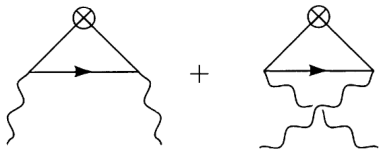
18.1 Matrix element for proton decay. Some advanced theories of particle interactions include heavy particles X whose couplings violate the conservation of baryon number. Integrating out these particles produces an effective interaction that allows the proton to decay to a positron and a photon or a pion. This effective interaction is most easily written using the definite-helicity components of the quark and electron fields: If uL, dL, uR, eR are two-component spinors, then this effective interaction is
ΔL=mX22ϵabcϵαβϵγδeRαuRaβuLbγdLcδ.
A typical value for the mass of the X boson is mX=1016 GeV.
(a) Estimate, in order of magnitude, the value of the proton lifetime if the proton is allowed to decay through this interaction.
(b) Show that the three-quark operator in ΔL has an anomalous dimension
γ=−4(4π)2g2.
Estimate the enhancement of the proton decay rate due to the leading QCD corrections.
18.2 Parity-violating deep inelastic form factor. In this problem, we first motivate the presence of additional deep inelastic form factors that are proportional to differences of quark and antiquark distribution functions. Then we define these functions formally and work out their properties.
(a) Analyze neutrino-proton scattering following the method used at the beginning of Section 18.5. Define
J+μ=uˉγμ(21−γ5)d,J−μ=dˉγμ(21−γ5)u.
Let
Wμν(ν)=2i∫d4xeiq⋅x⟨P∣T{J−μ(x)J+ν(0)}∣P⟩,
averaged over the proton spin. Show that the cross section for deep inelastic neutrino scattering can be computed from Wμν(ν) according to
(b) Show that any term in Wμν(ν) proportional to qμ or qν gives zero when contracted with the lepton momentum tensor in the formula above. Thus we can expand Wμν(ν) with three scalar form factors,
where the additional terms do not contribute to the deep inelastic cross section. Find the formula for the deep inelastic cross section in terms of the imaginary parts of W1(ν), W2(ν), and W3(ν).
(c) Evaluate the form factors Wi(ν) in the parton model, and show that
Im W1(ν)Im W2(ν)Im W3(ν)=π(fd(x)+fuˉ(x)),=ys4πx(fd(x)+fuˉ(x)),=ys2π(fd(x)−fuˉ(x)).
Insert these expressions into the formula derived in part (b) and show that the result reproduces the first line of Eq. (17.35).
(d) This analysis motivates the following definition: For a single quark flavor f, let
JfLμ=fˉγμ(21−γ5)f.
Define
WfLμν=2i∫d4xeiq⋅x⟨P∣T{JfLμ(x)JfLν(0)}∣P⟩.
Decompose this tensor according to
WfLμν=−gμνW1fL+PμPνW2fL+iϵμνλσPλqσW3fL+⋯,
where the remaining terms are proportional to qμ or qν. Evaluate the WiL in the parton model. Show that the quantities W1fL and W2fL reproduce the expressions for W1f and W2f given by Eqs. (18.120) and (18.144), and that W3fL is given by
Im W3fL=ys2π(ff(x)−ffˉ(x)).
(e) Compute the operator product of the currents in the expression for WfLμν, and write the terms in this product that involve twist-2 operators. Show that the expressions for W1fL and W2fL that follow from this analysis reproduce the expressions for W1f and W2f given by Eqs. (18.144) and (18.145). Find the corresponding expression for W3fL.
(f) Define the parton distribution ff− by the relation
ff−(x,Q2)=2πysImW3fL(x,Q2).
Show that, by virtue of this definition, the distribution function ff− satisfies the sum rule (18.155) for odd n.
18.3 Anomalous dimensions of gluon twist-2 operators.
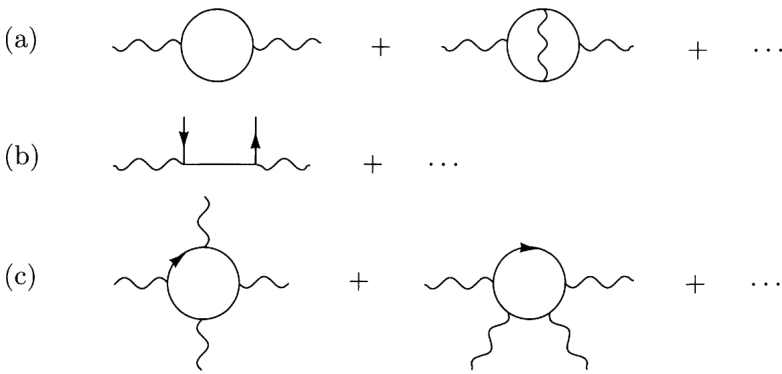
(a) Compute the divergent parts of the diagrams in Fig. 18.14, and use these to derive the second line of Eq. (18.181). Notice that this result holds only for n even. Show that the two diagrams cancel for n odd.
(b) Compute the divergent parts of the diagrams in Fig. 18.5, and use these to derive the third and fourth lines of Eq. (18.181).
18.4 Deep inelastic scattering from a photon. Consider the problem of deep-inelastic scattering of an electron from a photon. This process can actually be measured by analyzing the reaction e+e−→e+e−+X in the regime where the positron goes forward, with emission of a collinear photon, which then has a hard reaction with the electron. Let us analyze this process to leading order in QED and to leading-log order in QCD. To predict the photon structure functions, it is reasonable to integrate the renormalization group equations with the initial condition that the parton distribution for photons in the photon is δ(x−1) at Q2=(21 GeV)2. Take Λ=150 MeV. Assume for simplicity that there are four flavors of quarks, u,d,c, and s, with charges 2/3,−1/3,2/3,−1/3, respectively, and that it is always possible to ignore the masses of these quarks.
(a) Use the Altarelli-Parisi equations to compute the parton distributions for quarks and antiquarks in the photon, to leading order in QED and to zeroth order in QCD. Compute also the probability that the photon remains a photon as a function of Q2.
(b) Formulate the problem of computing the moments of W2 for the photon as a problem in operator mixing. Compute the relevant anomalous dimension matrix γ. You should be able to assemble this matrix from familiar ingredients without doing further Feynman diagram computations.
(c) Compute the n=2 moments of the photon structure functions as a function of Q2.
(d) Describe qualitatively the evolution of the photon structure function as a function of x and Q2.