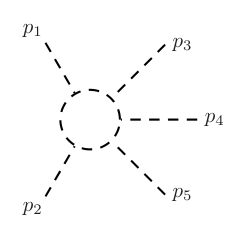
24.1 In this problem you will show how the cutting rules can be obtained directly from contour integration. (a) Where are the poles in the integrand in Eq. (24.29) in the complex k0 plane? (b) Close the contour upward and write the result as the sum of two residues. Show that one of these residues cannot contribute to the imaginary part of M. (c) Evaluate the imaginary part of the amplitude by using the other pole. Show that you reproduce Eq. (24.33). (d) Now consider a more complicated 2→3 process:
Explore the pole structure of this amplitude in the complex plane and show that the imaginary part of this amplitude is given by the cutting rules.
24.4 LSZ reduction formula in MS. (a) In a subtraction scheme other than on-shell subtraction, Z≡⟨Ω∣ϕ(0)∣p⟩=1. Use Eq. (24.105) to derive a relation between the 2-point function G2 and Z. (b) Calculate Z in MS in QED, including the counterterm contribution. You should find that Z=1, and for a massless electron, that Z is UV finite, IR divergent and differs from the MS field-strength renormalization factor Z2=1−216π2eR2εUV1. (c) Use Eq. (24.105) again to relate the S-matrix element S4=⟨p1p2∣p3p4⟩ to the Green's function G4. (d) Derive a relation between S-matrix elements and amputated Green's functions valid in MS. (d) What changes in the calculation of e+e−→μ+μ−(+γ) in Section 20.A if MS rather than the on-shell scheme is used?