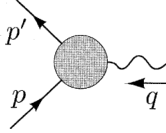
6.1 Rosenbluth formula. As discussed Section 6.2, the exact electromagnetic interaction vertex for a Dirac fermion can be written quite generally in terms of two form factors F1(q2) and F2(q2):
=uˉ(p′)[γμF1(q2)+2miσμνqνF2(q2)]u(p),
where q=p′−p and σμν=21i[γμ,γν]. If the fermion is a strongly interacting particle such as the proton, the form factors reflect the structure that results from the strong interactions and so are not easy to compute from first principles. However, these form factors can be determined experimentally. Consider the scattering of an electron with energy E≫me from a proton initially at rest. Show that the above expression for the vertex leads to the following expression (the Rosenbluth formula) for the elastic scattering cross section, computed to leading order in α but to all orders in the strong interactions:
where θ is the lab-frame scattering angle and F1 and F2 are to be evaluated at the q2 associated with elastic scattering at this angle. By measuring (dσ/dcosθ) as a function of angle, it is thus possible to extract F1 and F2. Note that when F1=1 and F2=0, the Rosenbluth formula reduces to the Mott formula (in the massless limit) for scattering off a point particle (see Problem 5.1).
6.2 Equivalent photon approximation. Consider the process in which electrons of very high energy scatter from a target. In leading order in α, the electron is connected to the target by one photon propagator. If the initial and final energies of the electron are E and E′, the photon will carry momentum q such that q2≈−2EE′(1−cosθ). In the limit of forward scattering, whatever the energy loss, the photon momentum approaches q2=0; thus the reaction is highly peaked in the forward direction. It is tempting to guess that, in this limit, the virtual photon becomes a real photon. Let us investigate in what sense that is true.
(a) The matrix element for the scattering process can be written as
M=(−ie)uˉ(p′)γμu(p)q2−igμνMν(q),
where Mν represents the (in general, complicated) coupling of the virtual photon to the target. Let us analyze the structure of the piece uˉ(p′)γμu(p). Let q=(q0,q), and define q~=(q0,−q). We can expand the spinor product as:
uˉ(p′)γμu(p)=A⋅qμ+B⋅q~μ+C⋅ϵ1μ+D⋅ϵ2μ,
where A,B,C,D are functions of the scattering angle and energy loss and ϵi are two unit vectors transverse to q. By dotting this expression with qμ, show that the coefficient B is at most of order θ2. This will mean that we can ignore it in the rest of the analysis. The coefficient A is large, but it is also irrelevant, since, by the Ward identity, qμMμ=0.
(b) Working in the frame where p=(E,0,0,E), compute explicitly
uˉ(p′)γ⋅ϵiu(p)
using massless electrons, u(p) and u(p′) spinors of definite helicity, and ϵ1,ϵ2 unit vectors parallel and perpendicular to the plane of scattering. We need this quantity only for scattering near the forward direction, and we need only the term of order θ. Note, however, that for ϵ in the plane of scattering, the small 3^ component of ϵ also gives a term of order θ which must be taken into account.
(c) Now write the expression for the electron scattering cross section, in terms of ∣Mμ∣2 and the integral over phase space on the target side. This expression must be integrated over the final electron momentum p′. The integral over p′3 is an integral over the energy loss of the electron. Show that the integral over p⊥′ diverges logarithmically as p⊥′ or θ→0.
(d) The divergence as θ→0 appears because we have ignored the electron mass in too many places. Show that reintroducing the electron mass in the expression for q2,
q2=−2(EE′−pp′cosθ)+2m2,
cuts off the divergence and yields a factor of log(s/m2) in its place.
(e) Assembling all the factors, and assuming that the target cross sections are independent of the photon polarization, show that the largest part of the electron-target scattering cross section is given by considering the electron to be the source of a beam of real photons with energy distribution (x=Eγ/E):
Nγ(x)dx=xdx2πα[1+(1−x)2]log(m2s).
This is the Weizsäcker-Williams equivalent photon approximation. This phenomenon allows us, for example, to study photon-photon scattering using e+e− collisions. Notice that the distribution we have found here is the same one that appeared in Problem 5.5 when we considered soft photon emission before electron scattering. It should be clear that a parallel general derivation can be constructed for that case.
6.3 Exotic contributions to g−2. Any particle that couples to the electron can produce a correction to the electron-photon form factors and, in particular, a correction to g−2. Because the electron g−2 agrees with QED to high accuracy, these corrections allow us to constrain the properties of hypothetical new particles.
(a) The unified theory of weak and electromagnetic interactions contains a scalar particle h called the Higgs boson, which couples to the electron according to
Hint=∫d3x2λhψˉψ.
Compute the contribution of a virtual Higgs boson to the electron (g−2), in terms of λ and the mass mh of the Higgs boson.
(b) QED accounts extremely well for the electron's anomalous magnetic moment. If a=(g−2)/2,
∣aexpt.−aQED∣<1×10⁻¹⁰.
What limits does this place on λ and mh? In the simplest version of the electroweak theory, λ=3×10⁻⁶ and mh>60 GeV. Show that these values are not excluded. The coupling of the Higgs boson to the muon is larger by a factor (mμ/me): λ=6×10⁻⁴. Thus, although our experimental knowledge of the muon anomalous magnetic moment is not as precise,
∣aexpt.−aQED∣<3×10⁻⁸,
one can still obtain a stronger limit on mh. Is it strong enough?
(c) Some more complex versions of this theory contain a pseudoscalar particle called the axion, which couples to the electron according to
Hint=∫d3x2iλaψˉγ5ψ.
The axion may be as light as the electron, or lighter, and may couple more strongly than the Higgs boson. Compute the contribution of a virtual axion to the g−2 of the electron, and work out the excluded values of λ and ma.