7.1

Problem 7.1

schwarzChapter 7

习题 7.1

来源: 第7章, PDF第103页


7.1 Consider the Lagrangian for ϕ3\phi^3 theory,

L=12ϕ(+m2)ϕ+g3!ϕ3.(7.122)\mathcal{L} = -\frac{1}{2} \phi (\square + m^2) \phi + \frac{g}{3!} \phi^3. \tag{7.122}

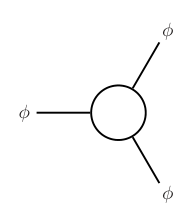
(a) Draw a tree-level Feynman diagram for the decay ϕϕϕ\phi \rightarrow \phi \phi. Write down the corresponding amplitude using the Feynman rules. (b) Now consider the one-loop correction, given by

A one-loop Feynman diagram for phi^3 theory showing a self-energy correction with an internal loop and external scalar field lines labeled with phi.
(7.123)\tag{7.123}

Write down the corresponding amplitude using the Feynman rules. (c) Now start over and write down the diagram from part (b) in position space, in terms of integrals over the intermediate points and Wick contractions, represented with factors of DFD_F. (d) Show that after you apply LSZ, what you got in (c) reduces to what you got in (b), by integrating the phases into δ\delta-functions, and integrating over those δ\delta-functions.

习题 7.1 - 解答


习题 7.1 分析与解答

对于 ϕ3\phi^3 理论,其拉格朗日量为: L=12ϕ(+m2)ϕ+g3!ϕ3\mathcal{L} = -\frac{1}{2} \phi (\square + m^2) \phi + \frac{g}{3!} \phi^3 由此可以得出动量空间中的费曼规则:

  1. 标量传播子:ip2m2+iϵ\frac{i}{p^2 - m^2 + i\epsilon}
  2. 相互作用顶点:igig (相互作用项为 +g3!ϕ3+\frac{g}{3!}\phi^3,展开后对称因子 3!3! 被抵消)

(a) 树图衰变 ϕϕϕ\phi \rightarrow \phi \phi

该过程的树图(Tree-level diagram)由一个单顶点组成,一条动量为 p1p_1 的入射线分裂为两条动量分别为 p2p_2p3p_3 的出射线。 根据费曼规则,该图仅包含一个顶点,没有内部传播子。因此,对应的散射振幅 iMi\mathcal{M} 直接就是顶点因子: iMtree=ig\boxed{i\mathcal{M}_{\text{tree}} = ig}


(b) 单圈修正振幅

题目给出的单圈图是一个顶点修正图(三角形图)。设入射动量为 p1p_1,出射动量为 p2p_2p3p_3,满足动量守恒 p1=p2+p3p_1 = p_2 + p_3。 我们在环路中设定动量流向:设连接出射动量 p2p_2 顶点和入射动量 p1p_1 顶点的内部线动量为 kk(从 p2p_2 顶点流向 p1p_1 顶点)。 根据动量守恒:

  • p1p_1 顶点流向 p3p_3 顶点的内部线动量为 k+p1k + p_1
  • p3p_3 顶点流向 p2p_2 顶点的内部线动量为 (k+p1)p3=k+p2(k + p_1) - p_3 = k + p_2

该图包含 3 个顶点和 3 条内部传播子,对称因子为 S=1S=1。根据费曼规则,写出对应的振幅: iM1-loop=(ig)3d4k(2π)4ik2m2+iϵi(k+p2)2m2+iϵi(k+p1)2m2+iϵ\boxed{i\mathcal{M}_{\text{1-loop}} = (ig)^3 \int \frac{d^4k}{(2\pi)^4} \frac{i}{k^2 - m^2 + i\epsilon} \frac{i}{(k+p_2)^2 - m^2 + i\epsilon} \frac{i}{(k+p_1)^2 - m^2 + i\epsilon}}


(c) 位置空间中的费曼图

在位置空间中,该图对应于格林函数 G(x1,x2,x3)=0T{ϕ(x1)ϕ(x2)ϕ(x3)}0G(x_1, x_2, x_3) = \langle 0 | T\{\phi(x_1)\phi(x_2)\phi(x_3)\} | 0 \rangle 在微扰展开中的 O(g3)\mathcal{O}(g^3) 连通项。 由 Dyson 级数展开,我们需要计算: i33!d4xd4yd4z0T{ϕ(x1)ϕ(x2)ϕ(x3)(g3!ϕ(x)3)(g3!ϕ(y)3)(g3!ϕ(z)3)}0conn\frac{i^3}{3!} \int d^4x d^4y d^4z \langle 0 | T\left\{\phi(x_1)\phi(x_2)\phi(x_3) \left(\frac{g}{3!}\phi(x)^3\right) \left(\frac{g}{3!}\phi(y)^3\right) \left(\frac{g}{3!}\phi(z)^3\right)\right\} | 0 \rangle_{\text{conn}} 通过 Wick 定理进行收缩以形成三角形图:

  1. 将外部点 x1,x2,x3x_1, x_2, x_3 分别与内部顶点 x,y,zx, y, z 收缩,共有 3!=63! = 6 种顶点分配方式。假设 x1x_1xxx2x_2yyx3x_3zz
  2. 在每个顶点处,有 3 种选择与外部线收缩。
  3. 剩下的场形成内部环路:xxyy2×2=42 \times 2 = 4 种),yyzz1×2=21 \times 2 = 2 种),zzxx1×1=11 \times 1 = 1 种)。 总的组合数为 6×(3×3×3)×(4×2×1)=12966 \times (3 \times 3 \times 3) \times (4 \times 2 \times 1) = 1296。这恰好抵消了分母中的对称因子 3!×(3!)3=12963! \times (3!)^3 = 1296

每次收缩产生一个费曼传播子 DF(xy)D_F(x-y)。因此,位置空间中该图的表达式为: G(x1,x2,x3)(ig)3d4xd4yd4zDF(x1x)DF(x2y)DF(x3z)DF(xy)DF(yz)DF(zx)\boxed{G(x_1, x_2, x_3) \supset (ig)^3 \int d^4x d^4y d^4z \, D_F(x_1-x) D_F(x_2-y) D_F(x_3-z) D_F(x-y) D_F(y-z) D_F(z-x)}


(d) 使用 LSZ 约化公式推导动量空间振幅

LSZ 约化公式将位置空间的格林函数与 S 矩阵元联系起来: p2,p3Sp1=d4x1d4x2d4x3eip1x1+ip2x2+ip3x3[i(x1+m2)][i(x2+m2)][i(x3+m2)]G(x1,x2,x3)\langle p_2, p_3 | S | p_1 \rangle = \int d^4x_1 d^4x_2 d^4x_3 \, e^{-ip_1 x_1 + ip_2 x_2 + ip_3 x_3} \left[ i(\square_{x_1} + m^2) \right] \left[ i(\square_{x_2} + m^2) \right] \left[ i(\square_{x_3} + m^2) \right] G(x_1, x_2, x_3) 利用传播子的性质 (w+m2)DF(wv)=iδ(4)(wv)(\square_w + m^2) D_F(w-v) = -i \delta^{(4)}(w-v),即 i(w+m2)DF(wv)=δ(4)(wv)i(\square_w + m^2) D_F(w-v) = \delta^{(4)}(w-v),作用于外部传播子可得: p2,p3Sp1=(ig)3d4xd4yd4zeip1x+ip2y+ip3zDF(xy)DF(yz)DF(zx)\langle p_2, p_3 | S | p_1 \rangle = (ig)^3 \int d^4x d^4y d^4z \, e^{-ip_1 x + ip_2 y + ip_3 z} D_F(x-y) D_F(y-z) D_F(z-x) 代入内部传播子的傅里叶变换形式 DF(xy)=d4k(2π)4ieik(xy)k2m2+iϵD_F(x-y) = \int \frac{d^4k}{(2\pi)^4} \frac{i e^{-ik(x-y)}}{k^2 - m^2 + i\epsilon}p2,p3Sp1=(ig)3d4xd4yd4zd4k1(2π)4d4k2(2π)4d4k3(2π)4ieik1(yx)k12m2ieik2(zy)k22m2ieik3(xz)k32m2eip1x+ip2y+ip3z\langle p_2, p_3 | S | p_1 \rangle = (ig)^3 \int d^4x d^4y d^4z \int \frac{d^4k_1}{(2\pi)^4} \frac{d^4k_2}{(2\pi)^4} \frac{d^4k_3}{(2\pi)^4} \frac{i e^{-ik_1(y-x)}}{k_1^2 - m^2} \frac{i e^{-ik_2(z-y)}}{k_2^2 - m^2} \frac{i e^{-ik_3(x-z)}}{k_3^2 - m^2} e^{-ip_1 x + ip_2 y + ip_3 z} (注:这里定义 k1k_1xx 流向 yyk2k_2yy 流向 zzk3k_3zz 流向 xx) 重排指数项并对空间坐标 x,y,zx, y, z 积分,产生动量守恒的 δ\delta 函数:

  • xx 积分:d4xeix(p1k1+k3)=(2π)4δ(4)(p1k1+k3)    k3=k1p1\int d^4x \, e^{-ix(p_1 - k_1 + k_3)} = (2\pi)^4 \delta^{(4)}(p_1 - k_1 + k_3) \implies k_3 = k_1 - p_1
  • yy 积分:d4yeiy(p2k2+k1)=(2π)4δ(4)(p2k2+k1)    k2=k1+p2\int d^4y \, e^{iy(p_2 - k_2 + k_1)} = (2\pi)^4 \delta^{(4)}(p_2 - k_2 + k_1) \implies k_2 = k_1 + p_2
  • zz 积分:d4zeiz(p3k3+k2)=(2π)4δ(4)(p3k3+k2)\int d^4z \, e^{iz(p_3 - k_3 + k_2)} = (2\pi)^4 \delta^{(4)}(p_3 - k_3 + k_2)

k2,k3k_2, k_3 的关系代入第三个 δ\delta 函数,得到整体动量守恒: δ(4)(p3(k1p1)+(k1+p2))=δ(4)(p1p2p3)\delta^{(4)}(p_3 - (k_1 - p_1) + (k_1 + p_2)) = \delta^{(4)}(p_1 - p_2 - p_3) 利用两个 δ\delta 函数积掉 k2k_2k3k_3,并令 k1=kk_1 = k,S 矩阵元化为: p2,p3Sp1=(2π)4δ(4)(p1p2p3)(ig)3d4k(2π)4ik2m2i(k+p2)2m2i(kp1)2m2\langle p_2, p_3 | S | p_1 \rangle = (2\pi)^4 \delta^{(4)}(p_1 - p_2 - p_3) (ig)^3 \int \frac{d^4k}{(2\pi)^4} \frac{i}{k^2 - m^2} \frac{i}{(k+p_2)^2 - m^2} \frac{i}{(k-p_1)^2 - m^2} 由于 (kp1)2=((kp1))2=(p1k)2(k-p_1)^2 = (-(k-p_1))^2 = (p_1-k)^2,若我们作变量代换 kkk \rightarrow -k,则分母变为 k2m2k^2 - m^2(k+p2)2m2=(kp2)2m2(-k+p_2)^2 - m^2 = (k-p_2)^2 - m^2(kp1)2m2=(k+p1)2m2(-k-p_1)^2 - m^2 = (k+p_1)^2 - m^2。 这与我们在 (b) 中选择的特定动量路由完全等价。根据定义 fSi=iM(2π)4δ(4)(p)\langle f | S | i \rangle = i\mathcal{M} (2\pi)^4 \delta^{(4)}(\sum p),提取出振幅: iM=(ig)3d4k(2π)4ik2m2+iϵi(k+p2)2m2+iϵi(k+p1)2m2+iϵ\boxed{i\mathcal{M} = (ig)^3 \int \frac{d^4k}{(2\pi)^4} \frac{i}{k^2 - m^2 + i\epsilon} \frac{i}{(k+p_2)^2 - m^2 + i\epsilon} \frac{i}{(k+p_1)^2 - m^2 + i\epsilon}} 这证明了通过 LSZ 约化位置空间表达式得到的结果与直接使用动量空间费曼规则得到的结果完全一致。
7.2

Problem 7.2

schwarzChapter 7

习题 7.2

来源: 第7章, PDF第103页


7.2 Calculate the contribution to 242 \rightarrow 4 scattering from the Lagrangian L=12ϕϕ+g3!ϕ3+16!λϕ6\mathcal{L} = -\frac{1}{2} \phi \square \phi + \frac{g}{3!} \phi^3 + \frac{1}{6!} \lambda \phi^6 from both the connected diagram, with the 6-point vertex, and the disconnected diagram with the 3-point vertex. Show that there is no interference between the two diagrams. (There are of course many connected diagrams with the 3-point vertex that you can ignore.)

习题 7.2 - 解答


习题分析与物理背景

由给定的拉格朗日量 L=12ϕϕ+g3!ϕ3+16!λϕ6\mathcal{L} = -\frac{1}{2} \phi \square \phi + \frac{g}{3!} \phi^3 + \frac{1}{6!} \lambda \phi^6 可知:

  1. 动能项为 12ϕϕ-\frac{1}{2} \phi \square \phi,没有质量项(即 m2=0m^2=0),因此该标量场 ϕ\phi 描述的是无质量粒子,满足在壳条件 p2=0p^2 = 0
  2. 相互作用项提供了两种顶点:
    • 3线顶点(3-point vertex),费曼规则为 igig
    • 6线顶点(6-point vertex),费曼规则为 iλi\lambda

对于 242 \rightarrow 4 散射过程,设初态动量为 p1,p2p_1, p_2,末态动量为 p3,p4,p5,p6p_3, p_4, p_5, p_6。总动量守恒要求 Pin=p1+p2=i=36pi=PoutP_{in} = p_1 + p_2 = \sum_{i=3}^6 p_i = P_{out}


1. 连通图 (Connected Diagram) 的贡献

连通图由单个 6线顶点构成,2个初态粒子和4个末态粒子直接交汇于一点。 根据费曼规则,6线顶点自带因子 iλi\lambda。由于拉格朗日量中的相互作用项为 λ6!ϕ6\frac{\lambda}{6!}\phi^6,6个外线与顶点收缩共有 6!6! 种组合,恰好抵消分母的 6!6!,因此对称因子为 1。

该连通图的 S 矩阵元为: Sc=iλ(2π)4δ4(p1+p2i=36pi)S_c = i\lambda (2\pi)^4 \delta^4\left(p_1 + p_2 - \sum_{i=3}^6 p_i\right) 提取出不变矩阵元 Mc\mathcal{M}_c(定义为 Sc=i(2π)4δ4(PinPout)McS_c = i(2\pi)^4\delta^4(P_{in}-P_{out})\mathcal{M}_c): Mc=λ\boxed{\mathcal{M}_c = \lambda}


2. 非连通图 (Disconnected Diagram) 的贡献

非连通图要求过程在拓扑上分离。对于 242 \rightarrow 4 过程且仅使用 3线顶点,最低阶的非连通图只能由两个独立的 121 \rightarrow 2 子过程组成(即每个初态粒子分别衰变为两个末态粒子)。

设末态粒子集合为 {3,4,5,6}\{3, 4, 5, 6\}。我们需要将其划分为两个包含2个粒子的子集,分别与 p1p_1p2p_2 关联。从4个末态粒子中选2个与 p1p_1 关联的方式有 (42)=6\binom{4}{2} = 6 种。这 6 种排列分别为:

  1. p1p3+p4p_1 \rightarrow p_3 + p_4, p2p5+p6p_2 \rightarrow p_5 + p_6
  2. p1p5+p6p_1 \rightarrow p_5 + p_6, p2p3+p4p_2 \rightarrow p_3 + p_4
  3. p1p3+p5p_1 \rightarrow p_3 + p_5, p2p4+p6p_2 \rightarrow p_4 + p_6
  4. p1p4+p6p_1 \rightarrow p_4 + p_6, p2p3+p5p_2 \rightarrow p_3 + p_5
  5. p1p3+p6p_1 \rightarrow p_3 + p_6, p2p4+p5p_2 \rightarrow p_4 + p_5
  6. p1p4+p5p_1 \rightarrow p_4 + p_5, p2p3+p6p_2 \rightarrow p_3 + p_6

对于任意一种划分(例如 p1pa+pbp_1 \rightarrow p_a + p_bp2pc+pdp_2 \rightarrow p_c + p_d),其 S 矩阵元是两个子过程 S 矩阵元的乘积。每个 3线顶点贡献 igig。 因此,总的非连通图 S 矩阵元为这 6 种可能性的叠加: Sdisc=g26 perms(2π)4δ4(p1papb)(2π)4δ4(p2pcpd)\boxed{ S_{disc} = -g^2 \sum_{\text{6 perms}} (2\pi)^4 \delta^4(p_1 - p_a - p_b) (2\pi)^4 \delta^4(p_2 - p_c - p_d) }


3. 证明两图之间无干涉 (No Interference)

散射截面或跃迁概率正比于 Sfi2=Sc+Sdisc2|S_{fi}|^2 = |S_c + S_{disc}|^2。干涉项正比于 ScSdisc+c.c.S_c S_{disc}^* + c.c.。 我们来分析干涉项 ScSdiscS_c S_{disc}^* 的结构。取 SdiscS_{disc} 中的任意一项(例如 p1pa+pbp_1 \rightarrow p_a + p_b),干涉项包含如下的狄拉克 δ\delta 函数乘积: ScSdiscδ4(p1+p2papbpcpd)×δ4(p1papb)×δ4(p2pcpd)S_c S_{disc}^* \propto \delta^4(p_1 + p_2 - p_a - p_b - p_c - p_d) \times \delta^4(p_1 - p_a - p_b) \times \delta^4(p_2 - p_c - p_d) 由于后两个 δ\delta 函数同时成立时,第一个全局动量守恒 δ\delta 函数必然成立,我们可以将全局动量守恒因子提取出来,干涉项在相空间积分中会留下一个额外的约束: InterferencedΠ4δ4(p1papb)\text{Interference} \propto \int d\Pi_4 \delta^4(p_1 - p_a - p_b) 其中 dΠ4d\Pi_4 是 4 体末态的洛伦兹不变相空间。上述积分等价于要求在相空间中计算一个无质量粒子 p1p_1 衰变为两个无质量粒子 pa,pbp_a, p_b 的 2 体相空间体积: d3pa(2π)32Ead3pb(2π)32Ebδ4(p1papb)\int \frac{d^3 p_a}{(2\pi)^3 2E_a} \frac{d^3 p_b}{(2\pi)^3 2E_b} \delta^4(p_1 - p_a - p_b)

运动学分析: 由于场 ϕ\phi 无质量,所有外线均满足 p2=0p^2 = 0。 由 δ\delta 函数约束 p1=pa+pbp_1 = p_a + p_b,两边平方得: p12=(pa+pb)2    0=pa2+pb2+2papb    0=2papbp_1^2 = (p_a + p_b)^2 \implies 0 = p_a^2 + p_b^2 + 2p_a \cdot p_b \implies 0 = 2p_a \cdot p_b 展开点积 papbp_a \cdot p_bpapb=EaEbpapb=EaEb(1cosθ)=0p_a \cdot p_b = E_a E_b - \vec{p}_a \cdot \vec{p}_b = E_a E_b (1 - \cos\theta) = 0 因为 Ea,Eb>0E_a, E_b > 0,该等式成立的唯一条件是 cosθ=1\cos\theta = 1,即末态粒子 pap_apbp_b 必须严格共线(Collinear)。

在相空间积分中,严格共线的参数空间维度比全相空间低,其测度为零(Measure zero)。因此,该相空间积分严格等于 0。 (注:从更一般的 S 矩阵理论来看,连通图与非连通图具有不同的动量守恒 δ\delta 函数结构,它们在物理相空间中的重叠测度始终为零,故在计算可观测的散射截面时互不干涉。)

dΠ4(ScSdisc+ScSdisc)=0    There is no interference between the two diagrams.\boxed{ \int d\Pi_4 \left( S_c S_{disc}^* + S_c^* S_{disc} \right) = 0 \implies \text{There is no interference between the two diagrams.} }

7.3

Problem 7.3

schwarzChapter 7

习题 7.3

来源: 第7章, PDF第103,104页


7.3 Non-relativistic Møller scattering: eeeee^- e^- \rightarrow e^- e^-. If the electron and photon were spinless, we could write the Lagrangian as

L=12ϕe(+me2)ϕe12A0A0+emeA0ϕeϕe,(7.124)\mathcal{L} = -\frac{1}{2} \phi_e (\square + m_e^2) \phi_e - \frac{1}{2} A_0 \square A_0 + e m_e A_0 \phi_e \phi_e, \tag{7.124}

where A0A_0 is the scalar potential and the factor of mem_e comes from the non-relativistic limit as in Section 5.2 (or by dimensional analysis!).

(a) Draw the three tree-level eeeee^- e^- \rightarrow e^- e^- diagrams following from this Lagrangian. (b) Which one of the diagrams would be forbidden in real QED? (c) Evaluate the other two diagrams, and express the answers in terms of s,ts, t and uu. Give the diagrams an extra relative minus sign, because electrons are fermions. (d) Now let us put back the spin. In the non-relativistic limit, the electron spin is conserved. This should be true at each vertex, since the photon is too soft to carry off any spin angular momentum. Thus, a vertex can only allow for ;γ|\uparrow\rangle \rightarrow |\uparrow; \gamma\rangle or ;γ|\downarrow\rangle \rightarrow |\downarrow; \gamma\rangle. This forbids, for example, |\uparrow\downarrow\rangle \rightarrow |\uparrow\uparrow\rangle from occurring. For each of the 16 possible sets of spins for the four electrons (for example |\uparrow\downarrow\rangle \rightarrow |\uparrow\uparrow\rangle), which processes are forbidden, and which get contributions from the ss-, tt- or uu-channels? (e) It is difficult to measure electron spins. Thus, assume the beams are unpolarized, meaning that they have an equal fraction of spin-up and spin-down electrons, and that you do not measure the final electron spins, only the scattering angle θ\theta. What is the total rate dσdcosθ\frac{d\sigma}{d \cos \theta} you would measure? Express the answer in terms of ECME_{\text{CM}} and θ\theta. Sketch the angular distribution.

习题 7.3 - 解答


(a) 树图分析 (Tree-level diagrams)

由拉格朗日量 LemeA0ϕeϕe\mathcal{L} \supset e m_e A_0 \phi_e \phi_e 可知,该理论包含一个由两个标量电子 ϕe\phi_e 和一个标量光子 A0A_0 组成的三线顶点。对于 e(p1)e(p2)e(p3)e(p4)e^-(p_1) e^-(p_2) \rightarrow e^-(p_3) e^-(p_4) 散射过程,在树图阶(tree-level)可以通过交换 A0A_0 场画出三个费曼图:

  1. ss-通道 (s-channel):两个入射电子 p1,p2p_1, p_2 湮灭产生一个虚 A0A_0 玻色子,随后该 A0A_0 衰变为两个出射电子 p3,p4p_3, p_4
  2. tt-通道 (t-channel):入射电子 p1p_1 发射一个虚 A0A_0 玻色子后变为出射电子 p3p_3,同时入射电子 p2p_2 吸收该 A0A_0 后变为出射电子 p4p_4
  3. uu-通道 (u-channel):与 tt-通道类似,但出射电子发生交换,即 p1p_1 发射 A0A_0 后变为 p4p_4p2p_2 吸收 A0A_0 后变为 p3p_3

(b) 真实 QED 中被禁戒的图

在真实的量子电动力学(QED)中,ss-通道图是被禁戒的物理原因:真实的电子带有守恒的 U(1)U(1) 电荷。ss-通道顶点 eeγe^- e^- \rightarrow \gamma 要求两个带负电的电子湮灭成一个电中性的光子,这违背了电荷守恒定律(20-2 \neq 0)。

(c) 计算 tt-通道与 uu-通道振幅

根据拉格朗日量,相互作用项为 emeA0ϕeϕee m_e A_0 \phi_e \phi_e。由于 ϕe\phi_e 是实标量场,包含两个全同场,顶点的费曼规则为 2ieme2 i e m_eA0A_0 场的动能项为 12A0A0-\frac{1}{2} A_0 \square A_0,其传播子为 iq2\frac{i}{q^2}

对于 tt-通道,动量转移为 q2=tq^2 = tiMt=(2ieme)it(2ieme)=4ie2me2t    Mt=4e2me2t-i \mathcal{M}_t = (2 i e m_e) \frac{i}{t} (2 i e m_e) = \frac{-4 i e^2 m_e^2}{t} \implies \mathcal{M}_t = \frac{4 e^2 m_e^2}{t}

对于 uu-通道,动量转移为 q2=uq^2 = uiMu=(2ieme)iu(2ieme)=4ie2me2u    Mu=4e2me2u-i \mathcal{M}_u = (2 i e m_e) \frac{i}{u} (2 i e m_e) = \frac{-4 i e^2 m_e^2}{u} \implies \mathcal{M}_u = \frac{4 e^2 m_e^2}{u}

由于电子实际上是费米子,交换两个全同的末态费米子会引入一个相对负号。因此,总散射振幅为: M=MtMu=4e2me2(1t1u)\boxed{ \mathcal{M} = \mathcal{M}_t - \mathcal{M}_u = 4 e^2 m_e^2 \left( \frac{1}{t} - \frac{1}{u} \right) }

(d) 考虑自旋守恒的 16 种构型

在非相对论极限下,软光子无法带走自旋角动量,因此每条费米子线在顶点处的自旋必须守恒。设过程为 σ1σ2σ3σ4|\sigma_1 \sigma_2\rangle \rightarrow |\sigma_3 \sigma_4\rangle

  • tt-通道连接 131 \rightarrow 3242 \rightarrow 4,要求 σ1=σ3\sigma_1 = \sigma_3σ2=σ4\sigma_2 = \sigma_4
  • uu-通道连接 141 \rightarrow 4232 \rightarrow 3,要求 σ1=σ4\sigma_1 = \sigma_4σ2=σ3\sigma_2 = \sigma_3
  • ss-通道在真实物理中被禁戒,不提供贡献。

在 16 种可能的自旋构型中:

  1. 同时获得 tt-通道和 uu-通道贡献(2种)|\uparrow \uparrow\rangle \rightarrow |\uparrow \uparrow\rangle |\downarrow \downarrow\rangle \rightarrow |\downarrow \downarrow\rangle
  2. 仅获得 tt-通道贡献(2种)|\uparrow \downarrow\rangle \rightarrow |\uparrow \downarrow\rangle |\downarrow \uparrow\rangle \rightarrow |\downarrow \uparrow\rangle
  3. 仅获得 uu-通道贡献(2种)|\uparrow \downarrow\rangle \rightarrow |\downarrow \uparrow\rangle |\downarrow \uparrow\rangle \rightarrow |\uparrow \downarrow\rangle
  4. 被禁戒的过程(10种): 任何不满足上述自旋守恒条件的构型均被禁戒(例如 |\uparrow \uparrow\rangle \rightarrow |\uparrow \downarrow\rangle, |\uparrow \downarrow\rangle \rightarrow |\uparrow \uparrow\rangle 等)。

(e) 非极化微分散射截面 dσdcosθ\frac{d\sigma}{d\cos\theta}

对于非极化束流,我们需要对初态自旋求平均(除以 4),并对末态自旋求和。利用 (d) 中的分析,非零振幅的平方和为: M2=2MtMu2+2Mt2+2Mu2\sum |\mathcal{M}|^2 = 2 |\mathcal{M}_t - \mathcal{M}_u|^2 + 2 |\mathcal{M}_t|^2 + 2 |-\mathcal{M}_u|^2 M2=14M2=Mt2+Mu2MtMu\overline{|\mathcal{M}|^2} = \frac{1}{4} \sum |\mathcal{M}|^2 = \mathcal{M}_t^2 + \mathcal{M}_u^2 - \mathcal{M}_t \mathcal{M}_u

代入 Mt\mathcal{M}_tMu\mathcal{M}_u 的表达式: M2=16e4me4(1t2+1u21tu)\overline{|\mathcal{M}|^2} = 16 e^4 m_e^4 \left( \frac{1}{t^2} + \frac{1}{u^2} - \frac{1}{tu} \right)

在质心系(CM)中,设三维动量大小为 pp。运动学变量为: t=2p2(1cosθ),u=2p2(1+cosθ)t = -2p^2(1 - \cos\theta), \quad u = -2p^2(1 + \cos\theta) 其中 p2=ECM24me2p^2 = \frac{E_{\text{CM}}^2}{4} - m_e^2。代入 M2\overline{|\mathcal{M}|^2} 中化简括号内的角分布部分: 1t2+1u21tu=14p4[1(1cosθ)2+1(1+cosθ)211cos2θ]\frac{1}{t^2} + \frac{1}{u^2} - \frac{1}{tu} = \frac{1}{4p^4} \left[ \frac{1}{(1-\cos\theta)^2} + \frac{1}{(1+\cos\theta)^2} - \frac{1}{1-\cos^2\theta} \right] =14p4[(1+cosθ)2+(1cosθ)2(1cos2θ)sin4θ]=14p41+3cos2θsin4θ= \frac{1}{4p^4} \left[ \frac{(1+\cos\theta)^2 + (1-\cos\theta)^2 - (1-\cos^2\theta)}{\sin^4\theta} \right] = \frac{1}{4p^4} \frac{1 + 3\cos^2\theta}{\sin^4\theta} 因此,自旋平均后的振幅平方为: M2=4e4me4p41+3cos2θsin4θ\overline{|\mathcal{M}|^2} = \frac{4 e^4 m_e^4}{p^4} \frac{1 + 3\cos^2\theta}{\sin^4\theta}

微分散射截面公式为 dσdΩ=164π2ECM2M2\frac{d\sigma}{d\Omega} = \frac{1}{64\pi^2 E_{\text{CM}}^2} \overline{|\mathcal{M}|^2}。由于 dΩ=2πdcosθd\Omega = 2\pi d\cos\theta,我们有: dσdcosθ=2π64π2ECM2M2=132πECM24e4me4p41+3cos2θsin4θ=e4me48πECM2p41+3cos2θsin4θ\frac{d\sigma}{d\cos\theta} = \frac{2\pi}{64\pi^2 E_{\text{CM}}^2} \overline{|\mathcal{M}|^2} = \frac{1}{32\pi E_{\text{CM}}^2} \frac{4 e^4 m_e^4}{p^4} \frac{1 + 3\cos^2\theta}{\sin^4\theta} = \frac{e^4 m_e^4}{8\pi E_{\text{CM}}^2 p^4} \frac{1 + 3\cos^2\theta}{\sin^4\theta}

p4=(ECM24me2)216p^4 = \frac{(E_{\text{CM}}^2 - 4m_e^2)^2}{16} 代入,得到最终的微分散射截面: dσdcosθ=2e4me4πECM2(ECM24me2)21+3cos2θsin4θ\boxed{ \frac{d\sigma}{d\cos\theta} = \frac{2 e^4 m_e^4}{\pi E_{\text{CM}}^2 (E_{\text{CM}}^2 - 4m_e^2)^2} \frac{1 + 3\cos^2\theta}{\sin^4\theta} } (注:若使用精细结构常数 α=e24π\alpha = \frac{e^2}{4\pi},系数可写为 32πα2me4ECM2(ECM24me2)2\frac{32 \pi \alpha^2 m_e^4}{E_{\text{CM}}^2 (E_{\text{CM}}^2 - 4m_e^2)^2})

角分布草图说明 (Sketch of the angular distribution): 角分布由形状函数 f(θ)=1+3cos2θsin4θf(\theta) = \frac{1 + 3\cos^2\theta}{\sin^4\theta} 决定。

  • θ0\theta \rightarrow 0(前向散射)和 θπ\theta \rightarrow \pi(后向散射)时,由于分母 sin4θ0\sin^4\theta \rightarrow 0,截面发生强烈的库仑发散(趋于正无穷)。
  • 函数在 θ=π/2\theta = \pi/2 处取得全局极小值,此时 f(π/2)=1f(\pi/2) = 1
  • 整体分布关于 θ=π/2\theta = \pi/2 呈对称的 U 型曲线。
7.4

Problem 7.4

schwarzChapter 7

习题 7.4

来源: 第7章, PDF第104页


7.4 We make a distinction between kinetic terms, which are bilinear in fields, and interactions, which have three or more fields. Time evolution with the kinetic terms is solved exactly as part of the free Hamiltonian. Suppose, instead, we only put the derivative terms in the free Hamiltonian and treated the mass as an interaction. So,

H0=12ϕϕ,Hint=12m2ϕ2.(7.125)H_0 = \frac{1}{2} \phi \square \phi, \quad H_{\text{int}} = \frac{1}{2} m^2 \phi^2. \tag{7.125}

(a) Draw the (somewhat degenerate looking) Feynman graphs that contribute to the 2-point function 0T{ϕ(x)ϕ(y)}0\langle 0|T\{\phi(x)\phi(y)\}|0\rangle using only this interaction, up to order m6m^6. (b) Evaluate the graphs. (c) Sum the series to all orders in m2m^2 and show you reproduce the propagator that would have come from taking H0=12ϕϕ+12m2ϕ2H_0 = \frac{1}{2} \phi \square \phi + \frac{1}{2} m^2 \phi^2. (d) Repeat the exercise classically: Solve for the massless propagator using an external current, perturb with the mass, sum the series, and show that you get the same answer as if you included the mass to begin with.

习题 7.4 - 解答


物理背景与题目分析

在标准的量子场论微扰展开中,通常将包含质量项的二次型部分作为自由哈密顿量 H0H_0,从而得到带有质量的传播子。本题要求我们改变微扰展开的基点:将无质量的动能项作为自由哈密顿量 H0H_0,而将质量项视为一种“相互作用” HintH_{\text{int}}

根据题目给定的哈密顿量: H0=12ϕϕ,Hint=12m2ϕ2H_0 = \frac{1}{2} \phi \square \phi, \quad H_{\text{int}} = \frac{1}{2} m^2 \phi^2 对应的拉格朗日量密度为 L0=12ϕϕ\mathcal{L}_0 = -\frac{1}{2} \phi \square \phi(等价于 12(μϕ)2\frac{1}{2}(\partial_\mu \phi)^2),以及相互作用拉格朗日量 Lint=Hint=12m2ϕ2\mathcal{L}_{\text{int}} = -H_{\text{int}} = -\frac{1}{2} m^2 \phi^2

由此可以得出两套费曼规则:

  1. 无质量自由传播子:在动量空间中为 D~0(p)=ip2+iϵ\tilde{D}_0(p) = \frac{i}{p^2 + i\epsilon}
  2. 质量插入顶点(Mass Insertion Vertex):由于 Lint=12m2ϕ2\mathcal{L}_{\text{int}} = -\frac{1}{2} m^2 \phi^2,包含两个相同的场 ϕ\phi,其顶点因子为 2!×(i12m2)=im22! \times \left(-i \frac{1}{2} m^2\right) = -i m^2。在费曼图中,该顶点表现为传播子线上打一个叉(\otimes)。

(a) 绘制费曼图 (Feynman Graphs up to order m6m^6)

计算两点格林函数 0T{ϕ(x)ϕ(y)}0\langle 0|T\{\phi(x)\phi(y)\}|0\rangle。由于质量插入顶点只包含两个场,它不会产生分支,只会像“念珠”一样串在一条线上。动量在顶点处守恒,因此整条线上流淌着相同的动量 pp

直到 O(m6)\mathcal{O}(m^6) 阶的费曼图如下(用文字与符号结构表示):

  • O(m0)\mathcal{O}(m^0):一条从 yyxx 的无质量传播子。 xpyx \bullet \xleftarrow{p} \bullet y
  • O(m2)\mathcal{O}(m^2):包含 1 个质量插入顶点(\otimes)。 xppyx \bullet \xleftarrow{p} \otimes \xleftarrow{p} \bullet y
  • O(m4)\mathcal{O}(m^4):包含 2 个质量插入顶点。 xpppyx \bullet \xleftarrow{p} \otimes \xleftarrow{p} \otimes \xleftarrow{p} \bullet y
  • O(m6)\mathcal{O}(m^6):包含 3 个质量插入顶点。 xppppyx \bullet \xleftarrow{p} \otimes \xleftarrow{p} \otimes \xleftarrow{p} \otimes \xleftarrow{p} \bullet y

(b) 计算费曼图 (Evaluate the graphs)

为了方便求和,我们在动量空间中计算这些图的表达式。设外部动量为 pp

  • O(m0)\mathcal{O}(m^0)D~(0)(p)=ip2+iϵ\tilde{D}^{(0)}(p) = \frac{i}{p^2 + i\epsilon}
  • O(m2)\mathcal{O}(m^2):两个传播子夹着一个顶点。 D~(1)(p)=ip2+iϵ(im2)ip2+iϵ=ip2+iϵ(m2p2+iϵ)\tilde{D}^{(1)}(p) = \frac{i}{p^2 + i\epsilon} (-i m^2) \frac{i}{p^2 + i\epsilon} = \frac{i}{p^2 + i\epsilon} \left( \frac{m^2}{p^2 + i\epsilon} \right)
  • O(m4)\mathcal{O}(m^4):三个传播子夹着两个顶点。 D~(2)(p)=ip2+iϵ(im2)ip2+iϵ(im2)ip2+iϵ=ip2+iϵ(m2p2+iϵ)2\tilde{D}^{(2)}(p) = \frac{i}{p^2 + i\epsilon} (-i m^2) \frac{i}{p^2 + i\epsilon} (-i m^2) \frac{i}{p^2 + i\epsilon} = \frac{i}{p^2 + i\epsilon} \left( \frac{m^2}{p^2 + i\epsilon} \right)^2
  • O(m6)\mathcal{O}(m^6):四个传播子夹着三个顶点。 D~(3)(p)=ip2+iϵ(m2p2+iϵ)3\tilde{D}^{(3)}(p) = \frac{i}{p^2 + i\epsilon} \left( \frac{m^2}{p^2 + i\epsilon} \right)^3

在位置空间中,完整的两点函数是上述动量空间表达式的傅里叶逆变换: 0T{ϕ(x)ϕ(y)}0=d4p(2π)4eip(xy)[D~(0)(p)+D~(1)(p)+D~(2)(p)+D~(3)(p)+]\langle 0|T\{\phi(x)\phi(y)\}|0\rangle = \int \frac{d^4p}{(2\pi)^4} e^{-ip \cdot (x-y)} \left[ \tilde{D}^{(0)}(p) + \tilde{D}^{(1)}(p) + \tilde{D}^{(2)}(p) + \tilde{D}^{(3)}(p) + \dots \right]


(c) 对所有阶求和 (Sum the series to all orders)

将所有阶的动量空间表达式相加,我们得到一个无穷级数: D~(p)=n=0D~(n)(p)=n=0ip2+iϵ(m2p2+iϵ)n\tilde{D}(p) = \sum_{n=0}^{\infty} \tilde{D}^{(n)}(p) = \sum_{n=0}^{\infty} \frac{i}{p^2 + i\epsilon} \left( \frac{m^2}{p^2 + i\epsilon} \right)^n

这是一个首项为 a=ip2+iϵa = \frac{i}{p^2 + i\epsilon},公比为 r=m2p2+iϵr = \frac{m^2}{p^2 + i\epsilon} 的等比数列(Geometric series)。利用无穷等比数列求和公式 n=0arn=a1r\sum_{n=0}^\infty a r^n = \frac{a}{1-r},我们得到: D~(p)=ip2+iϵ1m2p2+iϵ=ip2+iϵm2\tilde{D}(p) = \frac{\frac{i}{p^2 + i\epsilon}}{1 - \frac{m^2}{p^2 + i\epsilon}} = \frac{i}{p^2 + i\epsilon - m^2}

整理分母,得到最终的传播子: D~(p)=ip2m2+iϵ\boxed{ \tilde{D}(p) = \frac{i}{p^2 - m^2 + i\epsilon} } 这精确地再现了将质量项包含在自由哈密顿量 H0=12ϕϕ+12m2ϕ2H_0 = \frac{1}{2}\phi \square \phi + \frac{1}{2}m^2 \phi^2 中时所得到的标准有质量标量场传播子。


(d) 经典情形的重复 (Repeat the exercise classically)

在经典场论中,包含外源 J(x)J(x) 的完整作用量为: S=d4x[12ϕϕ12m2ϕ2+Jϕ]S = \int d^4x \left[ -\frac{1}{2}\phi \square \phi - \frac{1}{2}m^2 \phi^2 + J \phi \right] 对其变分得到完整的经典运动方程(EOM): ϕ+m2ϕ=J\square \phi + m^2 \phi = J

1. 求解无质量传播子(格林函数) 如果我们将质量项视为微扰,未微扰的无质量运动方程为 ϕ0=J\square \phi_0 = J。 在动量空间中,p2\square \to -p^2,因此无质量方程变为: p2ϕ~0(p)=J~(p)    ϕ~0(p)=1p2J~(p)-p^2 \tilde{\phi}_0(p) = \tilde{J}(p) \implies \tilde{\phi}_0(p) = -\frac{1}{p^2} \tilde{J}(p) 这表明无质量格林函数为 G~0(p)=1p2\tilde{G}_0(p) = -\frac{1}{p^2}

2. 引入质量微扰并迭代 将完整的运动方程改写为微扰形式: ϕ=Jm2ϕ\square \phi = J - m^2 \phi 在动量空间中,这等价于积分方程: p2ϕ~(p)=J~(p)m2ϕ~(p)    ϕ~(p)=1p2J~(p)+m2p2ϕ~(p)-p^2 \tilde{\phi}(p) = \tilde{J}(p) - m^2 \tilde{\phi}(p) \implies \tilde{\phi}(p) = -\frac{1}{p^2} \tilde{J}(p) + \frac{m^2}{p^2} \tilde{\phi}(p) 我们将上式不断迭代展开(即 Born 级数展开): ϕ~(p)=1p2J~(p)+m2p2(1p2J~(p)+m2p2ϕ~(p))\tilde{\phi}(p) = -\frac{1}{p^2} \tilde{J}(p) + \frac{m^2}{p^2} \left( -\frac{1}{p^2} \tilde{J}(p) + \frac{m^2}{p^2} \tilde{\phi}(p) \right) ϕ~(p)=1p2J~(p)m2p4J~(p)m4p6J~(p)\tilde{\phi}(p) = -\frac{1}{p^2} \tilde{J}(p) - \frac{m^2}{p^4} \tilde{J}(p) - \frac{m^4}{p^6} \tilde{J}(p) - \dots

3. 对级数求和 提取公因子 1p2J~(p)-\frac{1}{p^2} \tilde{J}(p),得到: ϕ~(p)=1p2[1+m2p2+(m2p2)2+]J~(p)\tilde{\phi}(p) = -\frac{1}{p^2} \left[ 1 + \frac{m^2}{p^2} + \left(\frac{m^2}{p^2}\right)^2 + \dots \right] \tilde{J}(p) 括号内同样是一个公比为 m2p2\frac{m^2}{p^2} 的等比数列。对其求和: ϕ~(p)=1p2(11m2p2)J~(p)=1p2m2J~(p)\tilde{\phi}(p) = -\frac{1}{p^2} \left( \frac{1}{1 - \frac{m^2}{p^2}} \right) \tilde{J}(p) = \frac{-1}{p^2 - m^2} \tilde{J}(p)

4. 验证等价性 如果我们一开始就保留质量项,完整的动量空间运动方程为: (p2+m2)ϕ~(p)=J~(p)    ϕ~(p)=1p2m2J~(p)(-p^2 + m^2) \tilde{\phi}(p) = \tilde{J}(p) \implies \tilde{\phi}(p) = \frac{-1}{p^2 - m^2} \tilde{J}(p) 这与我们通过无质量格林函数微扰迭代并求和得到的结果完全一致。 ϕ~(p)=1p2m2J~(p)\boxed{ \tilde{\phi}(p) = \frac{-1}{p^2 - m^2} \tilde{J}(p) }

7.5

Problem 7.5

schwarzChapter 7

习题 7.5

来源: 第7章, PDF第104页


7.5 Show in general that integrating by parts does not affect matrix elements.

习题 7.5 - 解答


物理背景与题意分析

在量子物理中,“分部积分不影响矩阵元”这一命题的核心在于:物理态的边界条件能量-动量守恒定律会使得分部积分过程中产生的边界项(或全导数项)严格为零

根据具体的物理语境,这一命题通常有两种表现形式:

  1. 量子力学(空间分部积分):在计算算符的空间积分矩阵元时,将空间导数从波函数的一部分转移到另一部分,边界项因波函数在无穷远处的衰减而消失。
  2. 量子场论(时空分部积分):在作用量或相互作用哈密顿量中进行时空分部积分,等价于相差一个全导数项 μΛμ\partial_\mu \Lambda^\mu。由于四维动量守恒,该全导数项的 S 矩阵元严格为零。

以下分别给出这两种情况的严谨证明。


1. 量子力学中的空间分部积分

O^\hat{O} 为一个包含空间导数的算符,不失一般性,将其写为 O^=A^iB^\hat{O} = \hat{A} \partial_i \hat{B},其中 i=xi\partial_i = \frac{\partial}{\partial x_i}。我们需要计算其在初态 ψi|\psi_i\rangle 和末态 ψf|\psi_f\rangle 之间的矩阵元: M=ψfO^ψi=Vd3xψf(x)A^(x)i[B^(x)ψi(x)]M = \langle \psi_f | \hat{O} | \psi_i \rangle = \int_V d^3x \, \psi_f^*(\vec{x}) \hat{A}(\vec{x}) \partial_i \left[ \hat{B}(\vec{x}) \psi_i(\vec{x}) \right]

利用导数的乘积法则(即分部积分的核心),被积函数可以改写为: ψfA^i(B^ψi)=i(ψfA^B^ψi)i(ψfA^)B^ψi\psi_f^* \hat{A} \partial_i (\hat{B} \psi_i) = \partial_i \left( \psi_f^* \hat{A} \hat{B} \psi_i \right) - \partial_i (\psi_f^* \hat{A}) \hat{B} \psi_i

将其代入积分中,得到两项: M=Vd3xi[ψf(x)A^(x)B^(x)ψi(x)]Vd3xi[ψf(x)A^(x)]B^(x)ψi(x)M = \int_V d^3x \, \partial_i \left[ \psi_f^*(\vec{x}) \hat{A}(\vec{x}) \hat{B}(\vec{x}) \psi_i(\vec{x}) \right] - \int_V d^3x \, \partial_i \left[ \psi_f^*(\vec{x}) \hat{A}(\vec{x}) \right] \hat{B}(\vec{x}) \psi_i(\vec{x})

对于第一项,利用高斯散度定理,可将体积分转化为包围体积 VV 的闭合曲面 V\partial V 上的面积分: Vd3xi(ψfA^B^ψi)=VdSiψf(x)A^(x)B^(x)ψi(x)\int_V d^3x \, \partial_i \left( \psi_f^* \hat{A} \hat{B} \psi_i \right) = \oint_{\partial V} dS_i \, \psi_f^*(\vec{x}) \hat{A}(\vec{x}) \hat{B}(\vec{x}) \psi_i(\vec{x})

物理近似与边界条件: 在量子力学中,物理态(如束缚态或波包)必须是平方可积(归一化)的,这意味着当 x|\vec{x}| \to \infty 时,波函数 ψ(x)0\psi(\vec{x}) \to 0。只要算符 A^,B^\hat{A}, \hat{B} 在无穷远处的发散速度不超过波函数的衰减速度,当积分区域 VV 扩展到全空间时,该面积分严格趋于零。

因此,边界项消失,矩阵元的值完全由第二项决定: d3xψfA^i(B^ψi)=d3xi(ψfA^)B^ψi\boxed{ \int d^3x \, \psi_f^* \hat{A} \partial_i (\hat{B} \psi_i) = - \int d^3x \, \partial_i (\psi_f^* \hat{A}) \hat{B} \psi_i } 这表明,通过分部积分将导数算符转移后,矩阵元的数值保持不变(这本质上也是动量算符 p^i=ii\hat{p}_i = -i\hbar\partial_i 具有厄米性的基础)。


2. 量子场论中的时空分部积分与全导数

在量子场论中,分部积分通常体现为在拉格朗日量密度中添加或减去一个四维全导数项 μΛμ(x)\partial_\mu \Lambda^\mu(x)。我们需要证明,全导数项在动量本征态 pi|p_i\ranglepf|p_f\rangle 之间的时空积分矩阵元(即对 S 矩阵的贡献)为零。

考虑全导数项的矩阵元: I=pfd4xμΛμ(x)pi=d4xμpfΛμ(x)piI = \langle p_f | \int d^4x \, \partial_\mu \Lambda^\mu(x) | p_i \rangle = \int d^4x \, \partial_\mu \langle p_f | \Lambda^\mu(x) | p_i \rangle

利用时空平移算符 P^μ\hat{P}^\mu,场算符的平移变换为 Λμ(x)=eiP^xΛμ(0)eiP^x\Lambda^\mu(x) = e^{i\hat{P}\cdot x} \Lambda^\mu(0) e^{-i\hat{P}\cdot x}。作用于动量本征态(满足 P^μp=pμp\hat{P}^\mu |p\rangle = p^\mu |p\rangle)上,可得: pfΛμ(x)pi=pfeiP^xΛμ(0)eiP^xpi=ei(pfpi)xpfΛμ(0)pi\langle p_f | \Lambda^\mu(x) | p_i \rangle = \langle p_f | e^{i\hat{P}\cdot x} \Lambda^\mu(0) e^{-i\hat{P}\cdot x} | p_i \rangle = e^{i(p_f - p_i)\cdot x} \langle p_f | \Lambda^\mu(0) | p_i \rangle

对其求四维散度 μ=xμ\partial_\mu = \frac{\partial}{\partial x^\mu}μpfΛμ(x)pi=i(pfpi)μei(pfpi)xpfΛμ(0)pi\partial_\mu \langle p_f | \Lambda^\mu(x) | p_i \rangle = i(p_f - p_i)_\mu e^{i(p_f - p_i)\cdot x} \langle p_f | \Lambda^\mu(0) | p_i \rangle

将此结果代回时空积分中: I=d4xi(pfpi)μei(pfpi)xpfΛμ(0)piI = \int d^4x \, i(p_f - p_i)_\mu e^{i(p_f - p_i)\cdot x} \langle p_f | \Lambda^\mu(0) | p_i \rangle

对时空坐标 xx 的积分会产生一个狄拉克 δ\delta 函数,体现了能量-动量守恒: d4xei(pfpi)x=(2π)4δ(4)(pfpi)\int d^4x \, e^{i(p_f - p_i)\cdot x} = (2\pi)^4 \delta^{(4)}(p_f - p_i)

因此,矩阵元化简为: I=i(2π)4[(pfpi)μδ(4)(pfpi)]pfΛμ(0)piI = i(2\pi)^4 \left[ (p_f - p_i)_\mu \delta^{(4)}(p_f - p_i) \right] \langle p_f | \Lambda^\mu(0) | p_i \rangle

计算技巧与结论: 根据狄拉克 δ\delta 函数的基本性质 xδ(x)0x \delta(x) \equiv 0,方括号中的项 (pfpi)μδ(4)(pfpi)(p_f - p_i)_\mu \delta^{(4)}(p_f - p_i) 严格为零。这意味着: d4xpfμΛμ(x)pi=0\boxed{ \int d^4x \langle p_f | \partial_\mu \Lambda^\mu(x) | p_i \rangle = 0 } 由此得证,在作用量中进行分部积分(即相差一个全导数项)不会对任何物理散射过程的矩阵元产生影响。

7.6

Problem 7.6

schwarzChapter 7

习题 7.6

来源: 第7章, PDF第104页


7.6 Use the Lagrangian

L=12ϕ1ϕ112ϕ2ϕ2+λ2ϕ1(μϕ2)(μϕ2)+g2ϕ12ϕ2(7.126)\mathcal{L} = -\frac{1}{2} \phi_1 \square \phi_1 - \frac{1}{2} \phi_2 \square \phi_2 + \frac{\lambda}{2} \phi_1 (\partial_\mu \phi_2)(\partial_\mu \phi_2) + \frac{g}{2} \phi_1^2 \phi_2 \tag{7.126}

to calculate the differential cross section

dσdΩ(ϕ1ϕ2ϕ1ϕ2)(7.127)\frac{d\sigma}{d\Omega} (\phi_1 \phi_2 \rightarrow \phi_1 \phi_2) \tag{7.127}

at tree level.

习题 7.6 - 解答


为了计算树图阶(tree-level)的微分散射截面 dσdΩ(ϕ1ϕ2ϕ1ϕ2)\frac{d\sigma}{d\Omega} (\phi_1 \phi_2 \rightarrow \phi_1 \phi_2),我们需要首先从拉格朗日量中提取费曼规则,然后计算所有可能的树图阶散射振幅,最后代入相空间公式求得截面。

1. 费曼规则与运动学变量

由给定的拉格朗日量: L=12ϕ1ϕ112ϕ2ϕ2+λ2ϕ1(μϕ2)(μϕ2)+g2ϕ12ϕ2\mathcal{L} = -\frac{1}{2} \phi_1 \square \phi_1 - \frac{1}{2} \phi_2 \square \phi_2 + \frac{\lambda}{2} \phi_1 (\partial_\mu \phi_2)(\partial^\mu \phi_2) + \frac{g}{2} \phi_1^2 \phi_2 可以得出以下费曼规则:

  1. 传播子:由于没有质量项,ϕ1\phi_1ϕ2\phi_2 均为无质量标量场,传播子均为 ip2\frac{i}{p^2}
  2. ϕ1ϕ1ϕ2\phi_1\phi_1\phi_2 相互作用顶点:由 g2ϕ12ϕ2\frac{g}{2} \phi_1^2 \phi_2 项给出,顶点因子为 igig(对称因子 2!2! 与分母 22 抵消)。
  3. ϕ1ϕ2ϕ2\phi_1\phi_2\phi_2 相互作用顶点:由 λ2ϕ1(μϕ2)(μϕ2)\frac{\lambda}{2} \phi_1 (\partial_\mu \phi_2)(\partial^\mu \phi_2) 项给出。导数作用在 ϕ2\phi_2 场上会引入动量因子。设两条 ϕ2\phi_2 线的流入动量分别为 pap_apbp_b,顶点因子为 iλ2×2!×(ipa)(ipb)=iλ(papb)i \frac{\lambda}{2} \times 2! \times (-i p_a) \cdot (-i p_b) = -i\lambda (p_a \cdot p_b)

设初态 ϕ1,ϕ2\phi_1, \phi_2 的动量分别为 p1,p2p_1, p_2,末态 ϕ1,ϕ2\phi_1, \phi_2 的动量分别为 p3,p4p_3, p_4。定义 Mandelstam 变量(由于粒子无质量,pi2=0p_i^2 = 0): s=(p1+p2)2=2p1p2=2p3p4s = (p_1 + p_2)^2 = 2p_1 \cdot p_2 = 2p_3 \cdot p_4 t=(p1p3)2=2p1p3=2p2p4t = (p_1 - p_3)^2 = -2p_1 \cdot p_3 = -2p_2 \cdot p_4 u=(p1p4)2=2p1p4=2p2p3u = (p_1 - p_4)^2 = -2p_1 \cdot p_4 = -2p_2 \cdot p_3 且满足 s+t+u=0s + t + u = 0

2. 树图阶散射振幅计算

对于过程 ϕ1(p1)ϕ2(p2)ϕ1(p3)ϕ2(p4)\phi_1(p_1) \phi_2(p_2) \rightarrow \phi_1(p_3) \phi_2(p_4),存在 ss 沟道和 uu 沟道的费曼图。由于拉格朗日量中不存在 ϕ13\phi_1^3ϕ23\phi_2^3 顶点,因此不存在 tt 沟道图

(1) ss 沟道图(中间态为 ϕ1\phi_1 两个顶点均为 ϕ1ϕ1ϕ2\phi_1\phi_1\phi_2,传递动量为 q=p1+p2q = p_1 + p_2iMs1=(ig)is(ig)    Ms1=g2si\mathcal{M}_{s1} = (ig) \frac{i}{s} (ig) \implies \mathcal{M}_{s1} = -\frac{g^2}{s}

(2) ss 沟道图(中间态为 ϕ2\phi_2 两个顶点均为 ϕ1ϕ2ϕ2\phi_1\phi_2\phi_2,传递动量为 q=p1+p2q = p_1 + p_2

  • 第一个顶点流入的 ϕ2\phi_2 动量为 p2p_2q=(p1+p2)-q = -(p_1+p_2),顶点因子为 iλ[p2((p1+p2))]=iλ(p1p2)=iλs2-i\lambda [p_2 \cdot (-(p_1+p_2))] = i\lambda (p_1 \cdot p_2) = i\lambda \frac{s}{2}
  • 第二个顶点流入的 ϕ2\phi_2 动量为 q=p1+p2q = p_1+p_2p4-p_4,顶点因子为 iλ[(p1+p2)(p4)]=iλ(p1p4+p2p4)=iλ(u2t2)=iλs2-i\lambda [(p_1+p_2) \cdot (-p_4)] = i\lambda (p_1 \cdot p_4 + p_2 \cdot p_4) = i\lambda \left(-\frac{u}{2} - \frac{t}{2}\right) = i\lambda \frac{s}{2}iMs2=(iλs2)is(iλs2)    Ms2=λ2s4i\mathcal{M}_{s2} = \left(i\lambda \frac{s}{2}\right) \frac{i}{s} \left(i\lambda \frac{s}{2}\right) \implies \mathcal{M}_{s2} = -\frac{\lambda^2 s}{4}

(3) uu 沟道图(中间态为 ϕ1\phi_1 两个顶点均为 ϕ1ϕ1ϕ2\phi_1\phi_1\phi_2,传递动量为 q=p1p4q = p_1 - p_4iMu1=(ig)iu(ig)    Mu1=g2ui\mathcal{M}_{u1} = (ig) \frac{i}{u} (ig) \implies \mathcal{M}_{u1} = -\frac{g^2}{u}

(4) uu 沟道图(中间态为 ϕ2\phi_2 两个顶点均为 ϕ1ϕ2ϕ2\phi_1\phi_2\phi_2,传递动量为 q=p1p4q = p_1 - p_4

  • 第一个顶点流入的 ϕ2\phi_2 动量为 p4-p_4q=(p1p4)-q = -(p_1-p_4),顶点因子为 iλ[p4((p1p4))]=iλ(p1p4)=iλu2-i\lambda [-p_4 \cdot (-(p_1-p_4))] = -i\lambda (p_1 \cdot p_4) = i\lambda \frac{u}{2}
  • 第二个顶点流入的 ϕ2\phi_2 动量为 q=p1p4q = p_1-p_4p2p_2,顶点因子为 iλ[(p1p4)p2]=iλ(p1p2p2p4)=iλ(s2+t2)=iλu2-i\lambda [(p_1-p_4) \cdot p_2] = -i\lambda (p_1 \cdot p_2 - p_2 \cdot p_4) = -i\lambda \left(\frac{s}{2} + \frac{t}{2}\right) = i\lambda \frac{u}{2}iMu2=(iλu2)iu(iλu2)    Mu2=λ2u4i\mathcal{M}_{u2} = \left(i\lambda \frac{u}{2}\right) \frac{i}{u} \left(i\lambda \frac{u}{2}\right) \implies \mathcal{M}_{u2} = -\frac{\lambda^2 u}{4}

总散射振幅: 将上述四项相加,并利用运动学关系 s+u=ts + u = -t 进行化简: M=Ms1+Ms2+Mu1+Mu2=g2(1s+1u)λ24(s+u)\mathcal{M} = \mathcal{M}_{s1} + \mathcal{M}_{s2} + \mathcal{M}_{u1} + \mathcal{M}_{u2} = -g^2 \left( \frac{1}{s} + \frac{1}{u} \right) - \frac{\lambda^2}{4} (s + u) M=g2(s+usu)λ24(s+u)=g2tsu+λ24t=t(g2su+λ24)\mathcal{M} = -g^2 \left( \frac{s+u}{su} \right) - \frac{\lambda^2}{4} (s+u) = g^2 \frac{t}{su} + \frac{\lambda^2}{4} t = t \left( \frac{g^2}{su} + \frac{\lambda^2}{4} \right)

3. 微分散射截面

对于无质量粒子的 222 \rightarrow 2 散射,质心系(CM frame)下的微分散射截面公式为: dσdΩ=M264π2s\frac{d\sigma}{d\Omega} = \frac{|\mathcal{M}|^2}{64\pi^2 s} 在质心系中,设散射角为 θ\theta,则 Mandelstam 变量可表示为: t=s2(1cosθ),u=s2(1+cosθ)t = -\frac{s}{2}(1 - \cos\theta), \quad u = -\frac{s}{2}(1 + \cos\theta)ttuu 代入总振幅 M\mathcal{M} 中: M=s2(1cosθ)[g2s(s2)(1+cosθ)+λ24]=(1cosθ)[g2s(1+cosθ)λ2s8]\mathcal{M} = -\frac{s}{2}(1-\cos\theta) \left[ \frac{g^2}{s \cdot \left(-\frac{s}{2}\right)(1+\cos\theta)} + \frac{\lambda^2}{4} \right] = (1-\cos\theta) \left[ \frac{g^2}{s(1+\cos\theta)} - \frac{\lambda^2 s}{8} \right] 对其取模平方并代入截面公式,即可得到最终的微分散射截面:

dσdΩ=(1cosθ)264π2s(g2s(1+cosθ)λ2s8)2\boxed{ \frac{d\sigma}{d\Omega} = \frac{(1-\cos\theta)^2}{64\pi^2 s} \left( \frac{g^2}{s(1+\cos\theta)} - \frac{\lambda^2 s}{8} \right)^2 }
7.7

Problem 7.7

schwarzChapter 7

习题 7.7

来源: 第7章, PDF第104,105页


7.7 Consider a Feynman diagram that looks like a regular tetrahedron, with the external lines coming out of the four corners. This can contribute to 222 \rightarrow 2 scattering in a scalar field theory with interaction λ4!ϕ4\frac{\lambda}{4!} \phi^4. You can take ϕ\phi to be massless.

(a) Write down the corresponding amplitude including the appropriate symmetry factor. (b) What would the symmetry factor be for the same diagram in ϕ3\phi^3 theory without the external lines?

习题 7.7 - 解答


习题 7.7 分析与解答

(a) ϕ4\phi^4 理论中 222 \rightarrow 2 散射的四面体图振幅及对称因子

1. 物理图像与图的拓扑结构分析λ4!ϕ4\frac{\lambda}{4!}\phi^4 理论中,每个顶点连接 4 条线。题目描述的费曼图是一个正四面体(Tetrahedron),具有 4 个顶点和 6 条边(内部传播子)。 对于 222 \rightarrow 2 散射,共有 4 条外线。题目指出外线从四面体的四个角(顶点)伸出,这意味着每个顶点恰好连接 1 条外线和 3 条内线。这完美符合 ϕ4\phi^4 理论的顶点规则(1+3=41+3=4)。

2. 对称因子 (Symmetry Factor) 计算 对称因子 SS 由图的自同构群的阶数决定,即 S=Aut(G)S = |\text{Aut}(G)|

  • 外线的可分辨性:4 条外线携带着不同的外部动量(设为 p1,p2,p3,p4p_1, p_2, p_3, p_4),这使得连接它们的 4 个顶点在拓扑上是完全可分辨的
  • 内部连线:在任意两个不同的顶点之间,恰好存在 1 条内部传播子(四面体的边)。不存在连接同一顶点的自环(self-loops),也不存在连接同一对顶点的多重边(multiple edges)。 由于顶点被外线固定且完全可分辨,且内部连线没有多重交换对称性,该图没有任何非平庸的置换对称性。因此,自同构群是平凡的,对称因子为: S=1S = 1

3. 动量分配与振幅写出 设 4 个外部动量均为流入方向,满足动量守恒 p1+p2+p3+p4=0p_1 + p_2 + p_3 + p_4 = 0。 图中有 6 条内线和 4 个顶点,独立的环路动量个数为 L=IV+1=64+1=3L = I - V + 1 = 6 - 4 + 1 = 3。我们引入 3 个独立的环路动量 k1,k2,k3k_1, k_2, k_3,并利用每个顶点的动量守恒来标记 6 条内线的动量:

  • 顶点 1 (流入 p1p_1) 流出到顶点 2, 3, 4 的动量分别为:k1k_1, k2k_2, p1k1k2p_1 - k_1 - k_2
  • 顶点 2 (流入 p2p_2) 接收 k1k_1,流出到顶点 3, 4 的动量分别为:k3k_3, p2+k1k3p_2 + k_1 - k_3
  • 顶点 3 (流入 p3p_3) 接收 k2k_2k3k_3,流出到顶点 4 的动量为:p3+k2+k3p_3 + k_2 + k_3
  • 顶点 4 接收来自前三个顶点的动量,总流入为 (p1k1k2)+(p2+k1k3)+(p3+k2+k3)=p1+p2+p3=p4(p_1 - k_1 - k_2) + (p_2 + k_1 - k_3) + (p_3 + k_2 + k_3) = p_1 + p_2 + p_3 = -p_4,恰好与外部动量 p4p_4 守恒。

根据费曼规则,每个顶点贡献 (iλ)(-i\lambda),每条无质量标量场的内线贡献 iq2+iϵ\frac{i}{q^2 + i\epsilon}。振幅 iMi\mathcal{M} 的表达式为: iM=1S(iλ)4d4k1(2π)4d4k2(2π)4d4k3(2π)4ik12ik22ik32i(p1k1k2)2i(p2+k1k3)2i(p3+k2+k3)2i\mathcal{M} = \frac{1}{S} (-i\lambda)^4 \int \frac{d^4k_1}{(2\pi)^4} \frac{d^4k_2}{(2\pi)^4} \frac{d^4k_3}{(2\pi)^4} \frac{i}{k_1^2} \frac{i}{k_2^2} \frac{i}{k_3^2} \frac{i}{(p_1-k_1-k_2)^2} \frac{i}{(p_2+k_1-k_3)^2} \frac{i}{(p_3+k_2+k_3)^2} 化简系数 (i)4(i)6=1(-i)^4 (i)^6 = -1,并默认分母带有 +iϵ+i\epsilon 极点处方,最终振幅为:

iM=λ4d4k1(2π)4d4k2(2π)4d4k3(2π)41k12k22k32(p1k1k2)2(p2+k1k3)2(p3+k2+k3)2(Symmetry factor S=1)\boxed{ i\mathcal{M} = -\lambda^4 \int \frac{d^4k_1}{(2\pi)^4} \frac{d^4k_2}{(2\pi)^4} \frac{d^4k_3}{(2\pi)^4} \frac{1}{k_1^2 k_2^2 k_3^2 (p_1-k_1-k_2)^2 (p_2+k_1-k_3)^2 (p_3+k_2+k_3)^2} \quad (\text{Symmetry factor } S=1) }


(b) ϕ3\phi^3 理论中无外线同构图的对称因子

1. 物理图像分析g3!ϕ3\frac{g}{3!}\phi^3 理论中,每个顶点连接 3 条线。 如果去掉 (a) 中的 4 条外线,剩下的图依然是一个正四面体。此时,4 个顶点中的每一个都恰好连接 3 条内部边。这完美符合 ϕ3\phi^3 理论的顶点规则。由于没有外线,这是一个真空图(Vacuum bubble)

2. 对称因子 (Symmetry Factor) 计算 在图论中,正四面体的骨架等价于 4 个顶点的完全图(Complete graph K4K_4)。

  • 顶点的不可分辨性:由于没有任何外线来标记或锚定这些顶点,这 4 个顶点在拓扑上是完全等价且不可分辨的。
  • 图的自同构群:在完全图 K4K_4 中,任意两个顶点之间都恰好有 1 条边相连。因此,对这 4 个顶点进行任意的置换(Permutation),都会将边映射到边,从而保持整个图的拓扑结构不变。
  • 4 个顶点的全排列构成了对称群 S4S_4

因此,该真空图的自同构群就是 S4S_4,其群的阶数(即对称因子)为 4 的阶乘: S=Aut(K4)=4!=24S = |\text{Aut}(K_4)| = 4! = 24

(注:也可以通过 Wick 收缩来验证。微扰展开分母包含 4!×(3!)4=311044! \times (3!)^4 = 31104。12 个场算符缩并成 K4K_4 拓扑的收缩方式共有 (3!)4=1296(3!)^4 = 1296 种。对称因子 S=311041296=24S = \frac{31104}{1296} = 24。)

S=24\boxed{ S = 24 }

7.8

Problem 7.8

schwarzChapter 7

习题 7.8

来源: 第7章, PDF第105页


7.8 Radioactive decay. The muon decays to an electron and two neutrinos through an intermediate massive particle called the WW^- boson. The muon, electron and WW^- all have charge 1-1. (a) Write down a Lagrangian that would allow for μeνˉeνμ\mu^- \rightarrow e^- \bar{\nu}_e \nu_\mu. Assume the WW and other particles are all scalars, and the ee^-, νe\nu_e and νμ\nu_\mu are massless. Call the coupling gg. (b) Calculate M2|\mathcal{M}|^2 for this decay in the limit that the WW mass, mWm_W, is large. (c) The decay rate Γ\Gamma (=1lifetime= \frac{1}{\text{lifetime}}) is proportional to M2|\mathcal{M}|^2. The coupling gg should be dimensionless (like the coupling ee for the photon), but appears dimensionful because we ignore spin. If the WW spin were included, you would get extra factors of pμp^\mu, which would turn into a factor of s=mμ\sqrt{s} = m_\mu in M2|\mathcal{M}|^2. Use dimensional analysis to figure out what power of mμm_\mu should be there. Also, throw in a 1192π3\frac{1}{192\pi^3} for the three-body phase space, as in Eq. (5.55) from Problem 5.3. (d) Let's guess that the coupling gg is close to the coupling for electromagnetism, so g24π1137\frac{g^2}{4\pi} \approx \frac{1}{137}. Use this and the muon mass (mμ=105 MeVm_\mu = 105\text{ MeV}) and lifetime (2.2×10⁶ s2.2 \times 10^{-6}\text{ s}) to estimate the WW mass. (e) The tauon, τ\tau, decays to eνˉeντe^- \bar{\nu}_e \nu_\tau. Use the τ\tau lifetime Γtot1=2.9×10¹³ s\Gamma_{\text{tot}}^{-1} = 2.9 \times 10^{-13}\text{ s} and previous parts to estimate the τ\tau mass. Which of mW,g,mμm_W, g, m_\mu, the muon lifetime, or the 192π3192\pi^3 we threw in does your prediction depend on? (f) In reality, the tauon only decays as τeνˉeντ\tau \rightarrow e^- \bar{\nu}_e \nu_\tau 17.8%17.8\% of the time. Use this fact to refine your τ\tau mass estimate. (g) How could you measure gg and MWM_W separately using precise measurements of the μ\mu and τ\tau decay distributions? What %\% precision would you need?


Referenced Equations:

Equation (5.3):

dσ=1T1ΦdP,(5.3)d\sigma = \frac{1}{T} \frac{1}{\Phi} dP, \tag{5.3}

Equation (5.55):

Γ=GF2m5192π3.(5.55)\Gamma = \frac{G_F^2 m^5}{192\pi^3}. \tag{5.55}

习题 7.8 - 解答


(a) 为了描述衰变 μeνˉeνμ\mu^- \rightarrow e^- \bar{\nu}_e \nu_\mu,我们需要包含两个相互作用顶点:μWνμ\mu^- \rightarrow W^- \nu_\muWeνˉeW^- \rightarrow e^- \bar{\nu}_e。由于假设所有粒子均为标量粒子,我们可以用复标量场来表示它们。根据电荷守恒,相互作用拉格朗日量可以写为:

Lint=gWμνμ+gWeνe+h.c.\mathcal{L}_{\text{int}} = g W^\dagger \mu \nu_\mu^\dagger + g W e^\dagger \nu_e + \text{h.c.}

其中 W,μ,e,νμ,νeW, \mu, e, \nu_\mu, \nu_e 分别代表对应粒子的标量场。第一项表示 μ\mu^- 湮灭并产生 WW^-νμ\nu_\mu;第二项表示 WW^- 湮灭并产生 ee^-νˉe\bar{\nu}_eνe\nu_e 场吸收电子中微子或产生反电子中微子)。

(b) 该衰变过程的费曼图包含两个顶点和一个 WW 玻色子传播子。根据费曼规则,振幅 M\mathcal{M} 为:

iM=(ig)ipW2mW2(ig)=ig2pW2mW2i\mathcal{M} = (ig) \frac{i}{p_W^2 - m_W^2} (ig) = -i\frac{g^2}{p_W^2 - m_W^2}

其中 pWp_WWW 玻色子的动量。在 WW 质量很大的极限下(mWpWm_W \gg p_W),传播子分母中的 pW2p_W^2 可以忽略,振幅简化为 Mg2mW2\mathcal{M} \approx \frac{g^2}{m_W^2}。因此,振幅的模平方为:

M2=g4mW4\boxed{|\mathcal{M}|^2 = \frac{g^4}{m_W^4}}

(c) 在自然单位制(=c=1\hbar = c = 1)中,衰变率 Γ\Gamma 的质量量纲为 [Γ]=1[\Gamma] = 1。 由于耦合常数 gg 是无量纲的,我们在 (b) 中得到的 M2=g4/mW4|\mathcal{M}|^2 = g^4 / m_W^4 的质量量纲为 4-4。 为了使 ΓM2\Gamma \propto |\mathcal{M}|^2 的量纲正确,我们需要补充质量量纲为 55 的因子。在忽略末态粒子质量的情况下,唯一可用的质量标度是初始粒子的质量 mμm_\mu。因此,必须乘以 mμ5m_\mu^5。结合题目给出的三体相空间因子 1192π3\frac{1}{192\pi^3},衰变率公式为:

Γ=g4mμ5192π3mW4\boxed{\Gamma = \frac{g^4 m_\mu^5}{192\pi^3 m_W^4}}

(d) 已知 g24π1137\frac{g^2}{4\pi} \approx \frac{1}{137},可得 g4=(4π137)20.00841g^4 = \left(\frac{4\pi}{137}\right)^2 \approx 0.00841。 衰变率 Γ\Gamma 与寿命 τ\tau 的关系为 Γ=τ\Gamma = \frac{\hbar}{\tau}。代入 6.582×10²² MeVs\hbar \approx 6.582 \times 10^{-22} \text{ MeV}\cdot\text{s}τ=2.2×10⁶ s\tau = 2.2 \times 10^{-6} \text{ s}

Γ=6.582×10222.2×1062.99×1016 MeV\Gamma = \frac{6.582 \times 10^{-22}}{2.2 \times 10^{-6}} \approx 2.99 \times 10^{-16} \text{ MeV}

由 (c) 中的公式解出 mWm_W

mW=(g4mμ5192π3Γ)1/4=(0.00841×(105 MeV)5192π3×2.99×1016 MeV)1/4(6.03×1019 MeV4)1/4m_W = \left( \frac{g^4 m_\mu^5}{192\pi^3 \Gamma} \right)^{1/4} = \left( \frac{0.00841 \times (105 \text{ MeV})^5}{192\pi^3 \times 2.99 \times 10^{-16} \text{ MeV}} \right)^{1/4} \approx \left( 6.03 \times 10^{19} \text{ MeV}^4 \right)^{1/4}
mW27800 MeV=27.8 GeV\boxed{m_W \approx 27800 \text{ MeV} = 27.8 \text{ GeV}}

(注:真实 WW 质量约为 80 GeV80\text{ GeV},这里的差异源于标准模型中弱耦合常数与电磁耦合常数的关系以及自旋带来的额外因子。)

(e) 对于 τ\tau 衰变,衰变率公式同理为 Γτ=g4mτ5192π3mW4\Gamma_\tau = \frac{g^4 m_\tau^5}{192\pi^3 m_W^4}。 将 τ\tau 衰变率与 μ\mu 衰变率相除,可得:

ΓτΓμ=(mτmμ)5    mτ=mμ(τμττ)1/5\frac{\Gamma_\tau}{\Gamma_\mu} = \left( \frac{m_\tau}{m_\mu} \right)^5 \implies m_\tau = m_\mu \left( \frac{\tau_\mu}{\tau_\tau} \right)^{1/5}

代入数值:

mτ=105 MeV×(2.2×106 s2.9×1013 s)1/5105×(7.586×106)1/5105×23.772496 MeVm_\tau = 105 \text{ MeV} \times \left( \frac{2.2 \times 10^{-6} \text{ s}}{2.9 \times 10^{-13} \text{ s}} \right)^{1/5} \approx 105 \times (7.586 \times 10^6)^{1/5} \approx 105 \times 23.77 \approx \boxed{2496 \text{ MeV}}

依赖关系:从推导可以看出,该预测仅依赖于 mμm_\muμ\mu 的寿命(以及给定的 τ\tau 寿命),而不依赖于 mWm_Wgg 或相空间因子 192π3192\pi^3

(f) 实际上 τeνˉeντ\tau \rightarrow e^- \bar{\nu}_e \nu_\tau 的分支比为 17.8%17.8\%,因此该通道的偏衰变宽为 Γτe=0.178Γtot=0.178ττ\Gamma_{\tau \rightarrow e} = 0.178 \Gamma_{\text{tot}} = \frac{0.178}{\tau_\tau}。 使用偏衰变宽重新计算:

0.178ΓtotΓμ=(mτmμ)5    mτ=mμ(0.178τμττ)1/5\frac{0.178 \Gamma_{\text{tot}}}{\Gamma_\mu} = \left( \frac{m_\tau}{m_\mu} \right)^5 \implies m_\tau = m_\mu \left( 0.178 \frac{\tau_\mu}{\tau_\tau} \right)^{1/5}

代入数值:

mτ=105 MeV×(0.178×7.586×106)1/5105×(1.35×106)1/5105×16.821766 MeVm_\tau = 105 \text{ MeV} \times \left( 0.178 \times 7.586 \times 10^6 \right)^{1/5} \approx 105 \times (1.35 \times 10^6)^{1/5} \approx 105 \times 16.82 \approx \boxed{1766 \text{ MeV}}

(这与真实的 τ\tau 质量 1776 MeV1776\text{ MeV} 非常接近!)

(g) 测量方法:在前面的计算中,我们使用了大质量极限 pW2mW2p_W^2 \ll m_W^2。如果不取此极限,传播子带来的振幅平方应为 1(mW2pW2)21mW4(1+2pW2mW2)\frac{1}{(m_W^2 - p_W^2)^2} \approx \frac{1}{m_W^4}\left(1 + 2\frac{p_W^2}{m_W^2}\right)。其中传递的动量平方 pW2p_W^2(即 eνˉee\bar{\nu}_e 系统的不变质量平方)在 00mμ2m_\mu^2(或 mτ2m_\tau^2)之间变化。这会导致衰变产物(如电子)的能量分布谱形状发生偏离纯点状相互作用的微小畸变。通过精确测量衰变能谱的形状畸变,可以单独拟合提取出 mWm_W;随后再结合总衰变率 Γg4/mW4\Gamma \propto g^4/m_W^4 即可提取出 gg

所需精度:能谱形状的修正量级为 (mmW)2\sim \left(\frac{m}{m_W}\right)^2

  • 对于 τ\tau 衰变,若使用 (d) 中估算的 mW27.8 GeVm_W \approx 27.8\text{ GeV},修正量级为 (1.7727.8)20.4%\left(\frac{1.77}{27.8}\right)^2 \approx 0.4\%(若使用真实质量 80 GeV80\text{ GeV},则为 0.05%\sim 0.05\%)。
  • 对于 μ\mu 衰变,修正量级为 (0.10527.8)20.0014%\left(\frac{0.105}{27.8}\right)^2 \approx 0.0014\%(若使用真实质量 80 GeV80\text{ GeV},则为 0.00017%\sim 0.00017\%)。 因此,需要对 τ\tau 衰变分布达到 0.1%\boxed{\sim 0.1\%} 的测量精度,或对 μ\mu 衰变分布达到 104%\boxed{\sim 10^{-4}\%} 的测量精度。
7.9

Problem 7.9

schwarzChapter 7

习题 7.9

来源: 第7章, PDF第105页


7.9 Unstable particles. Unstable particles pick up imaginary parts that generate a width Γ\Gamma in their resonance line shape. This problem will develop an understanding of what is meant by the terms width and pick up. (a) What would the cross section be for ss-channel scattering if the intermediate propagator were ip2m2+imΓ\frac{i}{p^2 - m^2 + im\Gamma}, where Γ>0\Gamma > 0? This is called the Breit-Wigner distribution. (b) Sketch the cross section as a function of x=sm2x = \frac{s}{m^2} for Γm\frac{\Gamma}{m} small and for Γm\frac{\Gamma}{m} large. (c) Show that a propagator only has an imaginary part if it goes on-shell. Explicitly, show that Im(M)=πδ(p2m2)\text{Im}(\mathcal{M}) = -\pi\delta(p^2 - m^2), when iM=ip2m2+iϵi\mathcal{M} = \frac{i}{p^2 - m^2 + i\epsilon}. (d) Loops of particles can produce effective interactions that have imaginary parts. Suppose we have another particle ψ\psi and an interaction ϕψψ\phi\psi\psi in the Lagrangian. Loops of ψ\psi will have imaginary parts if and only if ψ\psi is lighter than half of ϕ\phi, that is, if ϕψψ\phi \rightarrow \psi\psi is allowed kinematically. Draw a series of loop corrections to the ϕ\phi propagator. Show that, if these give an imaginary number, you can sum the graphs to reproduce the propagator in part (a). (e) What is the connection between parts (c) and (d)? Can you see why the width is related to the decay rate?

习题 7.9 - 解答


(a)ss-道散射中,散射振幅 M\mathcal{M} 包含中间态粒子的传播子。若传播子具有形式 ip2m2+imΓ\frac{i}{p^2 - m^2 + im\Gamma},且对于 ss-道有 p2=sp^2 = s,则散射振幅正比于该传播子: M1sm2+imΓ\mathcal{M} \propto \frac{1}{s - m^2 + im\Gamma} 散射截面 σ\sigma 正比于散射振幅模的平方 M2|\mathcal{M}|^2。忽略与 ss 依赖关系较弱的顶点耦合常数和相空间因子,截面的能量依赖形式为: σ(s)1sm2+imΓ2=1(sm2)2+m2Γ2\sigma(s) \propto \left| \frac{1}{s - m^2 + im\Gamma} \right|^2 = \frac{1}{(s - m^2)^2 + m^2\Gamma^2} 这就是著名的 Breit-Wigner 共振态分布。 σ(s)1(sm2)2+m2Γ2\boxed{ \sigma(s) \propto \frac{1}{(s - m^2)^2 + m^2\Gamma^2} }

(b) 引入无量纲变量 x=sm2x = \frac{s}{m^2},截面的形状函数可以写为: f(x)1(x1)2+(Γ/m)2f(x) \propto \frac{1}{(x - 1)^2 + (\Gamma/m)^2}

  • Γm\frac{\Gamma}{m} 很小(窄宽近似)时:函数在 x=1x = 1(即 s=m2s = m^2)处有一个极其尖锐且高耸的峰。峰值为 (m/Γ)2\propto (m/\Gamma)^2,半高全宽 (FWHM) 为 Δx2Γm\Delta x \approx 2\frac{\Gamma}{m}。这代表一个寿命较长的长寿命共振态(准束缚态)。
  • Γm\frac{\Gamma}{m} 很大时:函数在 x=1x = 1 处的峰变得非常平缓且宽阔,峰值较低,甚至可能与背景截面难以区分。这代表一个极不稳定的粒子,衰变极快,其质量具有很大的不确定度。

(注:由于纯文本限制,此处用文字描述图像特征。在实际作图中,横轴为 xx,纵轴为 σ\sigma。小 Γ/m\Gamma/m 对应一个类似 δ\delta 函数的尖峰;大 Γ/m\Gamma/m 对应一个低矮平缓的鼓包。)

(c) 已知振幅定义为 iM=ip2m2+iϵi\mathcal{M} = \frac{i}{p^2 - m^2 + i\epsilon},消去两侧的 ii 得到: M=1p2m2+iϵ\mathcal{M} = \frac{1}{p^2 - m^2 + i\epsilon} 利用复分析中的 Sokhotski–Plemelj 定理(或狄拉克恒等式): 1x+iϵ=P(1x)iπδ(x)\frac{1}{x + i\epsilon} = \mathcal{P}\left(\frac{1}{x}\right) - i\pi\delta(x) 其中 P\mathcal{P} 表示柯西主值。将其应用于 M\mathcal{M},令 x=p2m2x = p^2 - m^2M=P(1p2m2)iπδ(p2m2)\mathcal{M} = \mathcal{P}\left(\frac{1}{p^2 - m^2}\right) - i\pi\delta(p^2 - m^2) 取该复数表达式的虚部,直接得到: Im(M)=πδ(p2m2)\boxed{ \text{Im}(\mathcal{M}) = -\pi\delta(p^2 - m^2) } 物理意义δ(p2m2)\delta(p^2 - m^2) 强制要求 p2=m2p^2 = m^2。这表明,只有当传播的粒子满足质壳条件(on-shell,即成为真实的物理粒子而非虚粒子)时,传播子才会产生虚部。

(d) 考虑 ϕ\phi 传播子的单粒子不可约 (1PI) 圈图修正。设树图(裸)传播子为 D0(p)=ip2m02+iϵD_0(p) = \frac{i}{p^2 - m_0^2 + i\epsilon},由 ψ\psi 粒子圈图贡献的 1PI 自能记为 iΣ(p2)-i\Sigma(p^2)。 完整的传播子 D(p)D(p) 是所有 1PI 插入的几何级数求和(Dyson 方程): D(p)=D0+D0(iΣ)D0+D0(iΣ)D0(iΣ)D0+D(p) = D_0 + D_0(-i\Sigma)D_0 + D_0(-i\Sigma)D_0(-i\Sigma)D_0 + \dots 提取公因子并求无穷等比数列的和: D(p)=D0(p)1D0(p)(iΣ(p2))=ip2m021ip2m02(iΣ(p2))D(p) = \frac{D_0(p)}{1 - D_0(p)(-i\Sigma(p^2))} = \frac{\frac{i}{p^2 - m_0^2}}{1 - \frac{i}{p^2 - m_0^2}(-i\Sigma(p^2))} D(p)=ip2m02Σ(p2)D(p) = \frac{i}{p^2 - m_0^2 - \Sigma(p^2)} 自能通常是一个复数,可以分解为实部和虚部:Σ(p2)=ReΣ(p2)+iImΣ(p2)\Sigma(p^2) = \text{Re}\Sigma(p^2) + i\text{Im}\Sigma(p^2)。 实部 ReΣ(p2)\text{Re}\Sigma(p^2) 贡献了质量重整化,定义物理质量 m2m^2 满足 m2=m02+ReΣ(m2)m^2 = m_0^2 + \text{Re}\Sigma(m^2)。在质壳 p2m2p^2 \approx m^2 附近展开,传播子变为: D(p)ip2m2iImΣ(m2)D(p) \approx \frac{i}{p^2 - m^2 - i\text{Im}\Sigma(m^2)} 如果圈图积分给出了一个虚部,我们定义 ImΣ(m2)=mΓ\text{Im}\Sigma(m^2) = -m\Gamma (其中 Γ>0\Gamma > 0),则传播子精确化为 (a) 中的 Breit-Wigner 形式: D(p)=ip2m2+imΓ\boxed{ D(p) = \frac{i}{p^2 - m^2 + im\Gamma} }

(e) (c) 与 (d) 的联系: (c) 中证明了传播子只有在中间粒子 on-shell 时才会产生虚部。(d) 中的自能 Σ(p2)\Sigma(p^2) 是由 ψ\psi 粒子的圈图产生的。根据光学定理(Optical Theorem)或 Cutkosky 割线规则,圈图 Σ(p2)\Sigma(p^2) 的虚部等于将圈图中的内部 ψ\psi 传播子切断(即替换为 on-shell 的 δ\delta 函数,如 (c) 所示)后的相空间积分。 因此,Σ(p2)\Sigma(p^2) 具有虚部的充要条件是:中间态的两个 ψ\psi 粒子能够同时 on-shell。在质心系中,这要求运动学上允许衰变发生,即 mϕ>2mψm_\phi > 2m_\psi。如果 ψ\psi 太重,δ(p2mψ2)\delta(p^2 - m_\psi^2) 无法满足,自能就只有实部,ϕ\phi 就是稳定粒子。

宽度与衰变率的关系: 根据 Cutkosky 规则,自能图的虚部 2ImΣ(m2)2 \text{Im} \Sigma(m^2) 恰好等于 ϕψψ\phi \to \psi\psi 衰变振幅模平方的相空间积分(即总衰变率 Γdecay\Gamma_{\text{decay}} 乘以 2m2m)。 由 (d) 中的定义 ImΣ(m2)=mΓ- \text{Im}\Sigma(m^2) = m\Gamma,可得: Γ=ImΣ(m2)m=Γdecay\Gamma = \frac{-\text{Im}\Sigma(m^2)}{m} = \Gamma_{\text{decay}} 这解释了为什么 Breit-Wigner 分布中的参数 Γ\Gamma(共振峰的宽度)在物理上精确对应于该不稳定粒子的总衰变率 (Decay rate)。粒子的寿命 τ=1/Γ\tau = 1/\Gamma,衰变越快,Γ\Gamma 越大,共振峰越宽,这正是量子力学中能量-时间不确定性原理 ΔEΔt1\Delta E \Delta t \sim 1 的体现。